Showing posts with label Spotted Flycatcher. Show all posts

Monday, 7 February 2022

2021 Season and Ringing Totals

Despite the inactivity on the blog, the nets were up and open with regularity throughout the autumn and into early winter. Covid restrictions had an impact on the early season ringing and have resulted in lower totals, as below. There have also some changes to the group with John Clarke retiring from ringing after c20 years and Ken taking a temporary step back, but keen to continue again in 2022. On the plus side, Dean Jones has returned to the North Coast following a number of years working as the Warden on Lundy Island, Devon, where he was observing the likes of the Sulphur-bellied Warbler and ringing Wrynecks, Subalpine Warblers etc; birds which we can only dream of up here. David Stirling has achieved his C permit and the two are now set up with their own equipment and rings and ready for action. Steve Fyffe has advanced to his A/Supervisor permit. I have put the ringing on ice so far this year following the birth of my first child in mid-January but I hope to get back into action in spring, although at a reduced level. 

Regular updates continue on Twitter @CausewayBirds. 

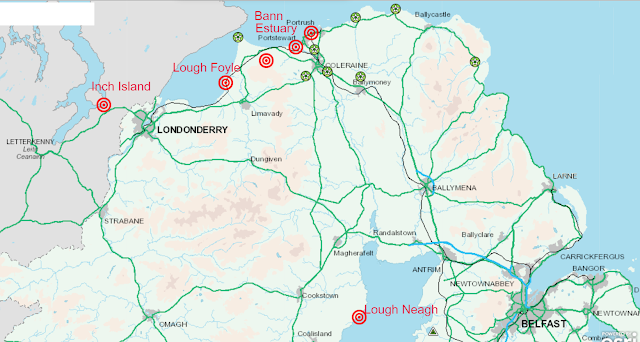
Activity was focused once again on the Inch Island Wildfowl Reserve in County Donegal for the Sandwich Tern colour ringing project, the Bann Estuary for breeding/migrating/wintering passerines, Lough Foyle for waders and winter farmland birds, Lough Neagh for breeding/migrating warblers, and the new upland site, referenced in the post below, for breeding birds. I have also marked Portmore Lough below (triangle to the east of Lough Neagh) which will be the site of a trail Constant Effort Site (CES) led by Steve in 2022. 

A total of 1549 birds were ringed of 51 species and a further 105 birds retrapped or controlled. 


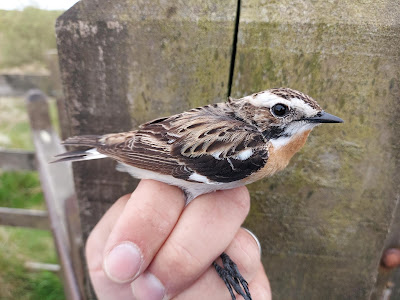
There were no rare or scarce birds ringed at the migration sites but the two Whinchats were a new species for the group. 


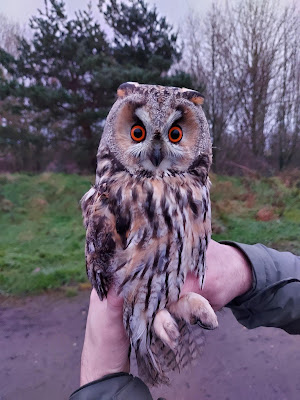
We were able to get out to the local woods to locate multiple pairs of breeding Long-eared Owls but did not have any opportunities to ring them. One Long-eared Owl did make an appearance at our farmland bird site on the shores of Lough Foyle. No sign of any of the local Barn Owls just yet though.

Spotted Flycatcher was another that we seldom ring, and this one was caught randomly on an upland bog, presumably on passage. 
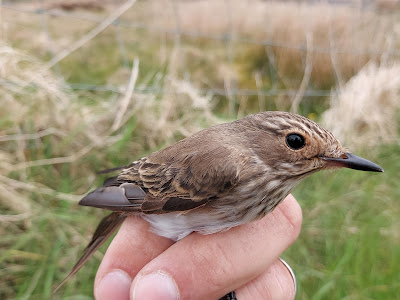

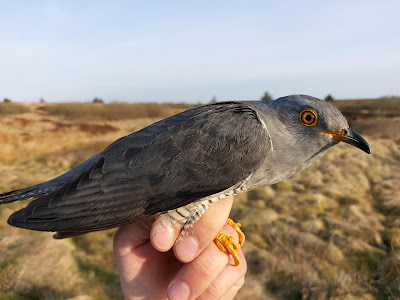
The upland bog site produced a nice range of breeding birds including the Whinchats, Spotted Flycatcher, Jay and two Cuckoos. A Red Grouse managed to escape the mist net it bounced into and would have been a very rare catch. 

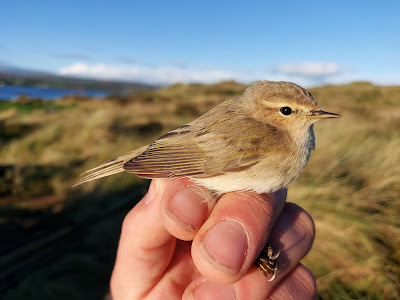
This putative Siberian Chiffchaff (Phylloscopus collybita tristis) trapped in October at Portstewart Strand should also be a new sub-species for the group and we are awaiting the DNA sequencing to confirm or otherwise. 

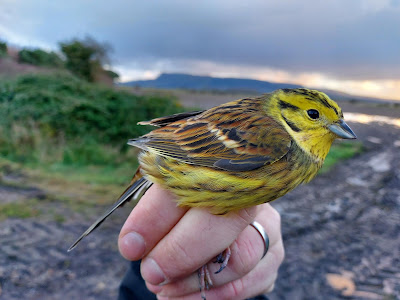
Farmland bird numbers were low, having missed any ringing from Jan-Apr, but four Yellowhammers at the end of the year added a splash of colour. There were also five plus Bramblings present at the site but none caught. 


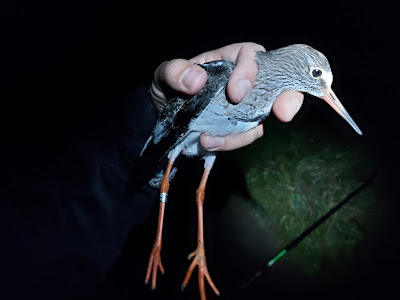
Wader ringing was very limited with one attempt lamping at both Lough Foyle and the Bann Estuary producing just eight Dunlin and eight Redshank. This will undoubtedly be improved in 2022.
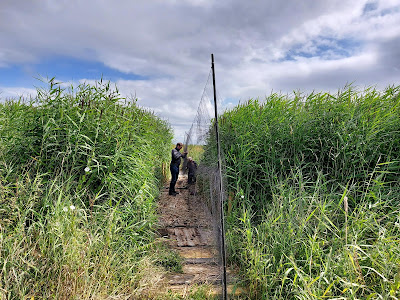
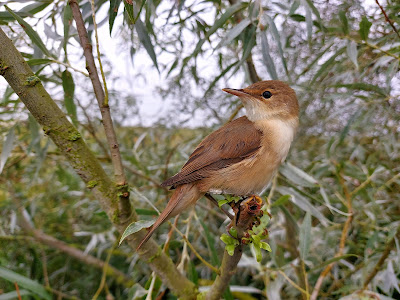
The reedbeds along the west shore of Lough Neagh were again very productive with 552 new birds across five sessions, including 365 Sedge and 86 Reed Warblers. Recoveries included a Blackcap to County Roscommon 3 years later, a Sedge Warbler to Wales, one Sedge from Dorset and two local movements along the Lough Neagh shore. 

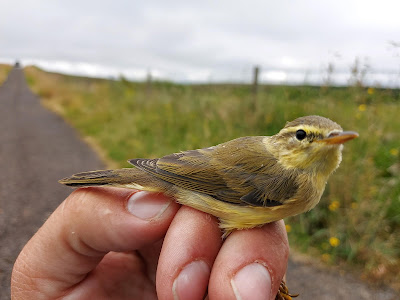
It was our third best year for Willow Warblers with 73 new, thanks to the 41 ringed at the upland bog. This will hopefully increase our chances of our first recovery of this species 

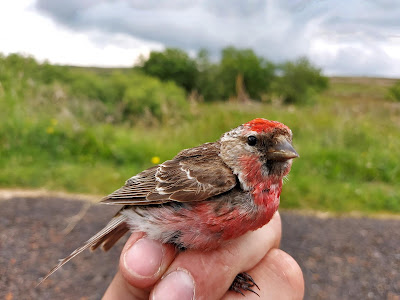
We haven't caught many Lesser Redpolls in recent years in the absence of garden feeder ringing so the 40 caught at the upland bog boosted numbers. A Dutch redpoll ringed in October 2020 at Heisteeg, Tilburg, Noord-Brabant, was a nice catch. A second recovery was also received from Yorkshire, England, originally ringed in November 2020. 

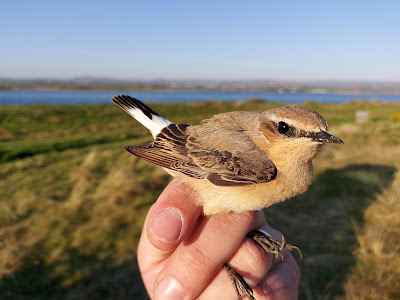
Four Wheatears were nice, all caught in mist nests in scrub. Three of these were Greenland Wheatears (Oenanthe oenanthe leucorhoa). The four matches the total in 2014 (4 pulli) and just the 9th-12th ringed by the group. 

Ken continued his nest box studies on Blue and Great Tits, although now studying around 10% of his former very large project at the Ulster University campus. Just two visits were made to catch Storm Petrels near Portstewart with 48 caught in total. 

Further recoveries included a Sedge Warbler and Sand Martin to the Loire-Atlantique area of western France and some more UK & Ireland Storm Petrel movements. The colour ringed Sandwich Terns were again appearing in the UK and South Africa and will be covered at another time. There were plenty of colour ring sightings including Ringed Plover, Oystercatcher, Black-headed Gull, Lesser Black-backed Gull, Herring Gull, Sandwich Tern, Whooper Swan and Brent Goose - I may cover our recoveries in another post which now top 400. 

A very quick round up of the year but hopefully the updates will be a little more forthcoming in 2022.


Tuesday, 20 June 2017

Copeland Bird Observatory 19-21st May 2017

I was out at Copeland Bird Observatory for my third weekend of the year with a large party of two from the Observatory, six from the Belfast and Down Ringing Group, a rabbit researcher from Queens University Belfast and myself.  The forecast didn't promise much in the way of movement but as ever I'm always hopeful for something nice turn up in the nets.

As predicted the winds weren't overly compliant and migrants were thin on the ground.  We didn't totally hit a blank and trapped 2 Chiffchaff, a single Sedge Warbler and a late Redwing.  The girls from BDRG got a bit of practice catching and handling large gulls trapping three Herring Gulls and one Lesser-black Backed Gull on Saturday afternoon using nest traps.

Redwing

On Friday night Rosie and Terry set up the moth trap around the garden pond in ideal conditions.  It was a decent catch with the Poplar Hawk moth looking the most spectacular plus 151 Campion, 1 Clouded Border, 20 White Ermine, 2 Flame Shoulder, 1 Angle Shades, 1 Sandy Carpet, 2 Spectacle, 3 Broom moths, a possible Bullrush Wainscott, possibly 4 Red-headed Chestnut, possibly 1 Twin-spot carpet and 17 unidentified micros, a couple rather dapper looking.  It is great spot for moth trapping although there has been little trapping in the past 10+ years.  Other lepidotera included c20 Green-veined White, 1 Red Admiral and 1 Speckled Wood butterflies.  As Records Secretary at the observatory I've not yet had the chance to look at any records other than birds yet but once I get everything in order I hope to work on the likes of cetaceans and moths etc.   

Poplar Hawk Moth

White Ermine

On Sunday afternoon, after news of our delayed boat, I spent a bit of time doing a full island gull count and searching for nests amongst the scrub.  A full circumference of the island produced c395 Lesser Black-backed Gulls, c360 Herring Gulls, 63 Common Gulls, 2 Great Black-back Gull nests and a few other bits and pieces including 11 pairs of Oystercatcher, at least 3 Fulmar nests with eggs (no doubt more) and a single Eider nest much higher up the shore than normal (there will have been plenty more on the lower shore but I didn't want to disturb the birds - there were 19 new female Eiders and 22 retraps caught midweek on Mew Island).  I had a bit of luck with some of the larger nests and turned up three occupied Woodpigeon nests and a single Magpie nest.  The Magpie nest, with five eggs, was actually within 40cm of a Woodpigeon next with two eggs as pictured below.  The other two WP nests had 2 well developed chicks and a single egg.

Woodpigeon nest to left and Magpie nest slightly up right
 
Woodpigeon chicks

Another benefit of the delayed boat was the sighting of a Marsh Harrier that drifted across to Mew Island as we sat in the hide late afternoon.  The large gulls didn't take kindly to its presence and it was swiftly escorted away.  Marsh Harriers are very uncommon in NI with only a handful of sightings in a good year and probably only 3-5 sighted at CBO since 1954. 

Copeland Bird Observatory 19-21/05/2017                           
                                                   New       Retrap    

Blackbird                                                      1
Chiffchaff                                    1                1
Goldfinch                                     1               1                                             
Jackdaw                                       1
Herring Gull                                 3
Lesser-black Backed Gull          1      
Pied Wagtail                                1
Redwing                                       1         
Reed Bunting                               2               5
Robin                                            1               2

Rock Pipit                                    1               1
Sedge Warbler                            1
Swallow                                        2
Woodpigeon                                2 (pulli)
Wren                                            2               1          


Totals                                          20              12           

Sundown over the Pub


Davis S went out to CBO the weekend before and despite being restricted by strong winds caught a further five Whitethroats and turned up the first Spotted Flycatchers of the year with two caught. 

Copeland Bird Observatory 12-14/05/2017                           
                                New       Retrap    

Chiffchaff                  3               
Manx Shearwater     1                                                           
Pied Wagtail             1           
Reed Bunting                           5            
Robin                                        

Rock Pipit                                1
Sedge Warbler         1
Spotted Flycatcher  2    
Whitethroat              5
Willow Warbler        3
 Wren                                       1                            


Totals                      16              7                   

Spotted Flycatcher

Spot the Puffin decoys

30 minutes with a scythe cleaned up the Puffing breeding bank

The real deal
 

Monday, 3 October 2016

Cape Clear Bird Observatory 22-25 September

This weekend seen myself (Dean) and another trainee from the North, David S, head down to Cape Clear Bird Observatory to help trial the new bird ringing course.  After a rather long but fun filled drive from the north (6.5 hours), David and myself set off from the lovely seaside town of Baltimore for Cape Clear at around 18:00.  As we made our way out of the sheltered bay composed of a scattering of small islands and islets we were hit by strong south westerly winds.  Immediately our quick pint and a pizza at Baltimore didn’t seem like such a good idea as the ferry was met by the rather daunting swell.  Our sea legs faired however leaving us to enjoy a superb journey from Baltimore.  On route we were blessed with sightings of numerous Gannets, Black-headed Gulls and a lovely raft of around 100 Kittiwakes just off the North end of the island.  Slowly but surely we powered into Cape’s waters, eventually reaching a small islet located along the north west stretch of the island aptly named “Bird Island”.  As we approached we realised the islet was covered in Cormorant, Shag and a small number of Great black-backed Gulls.  Then as I was making some brief counts, something small and pale floating on the surface of the water caught my eye.  After raising my bins I was surprised to see a Grey Phalarope floating between the now reserved bouts of swell, David and I were delighted!  A new lifer for us both and we hadn’t even landed on the island yet, a sign of great things to come we thought! 


We landed in North harbour at around 19:00 and were met off the boat by Sam Bayley the current Wildlife Officer at Cape Clear Bird Observatory who, after helping us lug our kit to the observatory building, gave us a bit of a tour and a brief introduction to the island and the other bird ringers involved in the course.  We were both pretty wrecked from the long Diet Coke fuelled journey so after the evening log and a quick hot toddy we settled down for an early night to try and re-charge the batteries for the excitement ahead.

Goldcrest sheltering from the wind (DJ)

 
The next morning we split up into two groups and set off to unfurl the nets at two different sites on the island by 06:00am. Things were rather breezy as we arrived, though better than predicted, which enabled us to catch a small number of Goldcrest, Blackbird and Dunnock amongst others. We also made an attempt at catching some Meadow Pipit which were fluttering in small numbers around the site but the weather didn't work with us.  Disappointingly the winds then picked up leading us to furl the nets and leave the site a few hours earlier than planned.  We caught up with the other group by an area called the Nordy Wood, a lush area of mixed native woodland species which were planted there a number of years ago by another group of Northerners.  The other group faired roughly the same as us though they were lucky enough to catch the only Blackcap and Song Thrush of the weekend as well as a new Chiffchaff.  As we were getting ready to pack up at this site we got the news of a juvenile Common Rosefinch which was spotted in a Sycamore tree not far from where we had set up base.  David and I couldn’t pass up the chance for bagging another lifer so we set out to see if we could catch a glimpse, unfortunately we dipped!

Chiffchaff (DS)


The south westerly gales battered on through the afternoon squandering any attempts to get out ringing again.  Instead we equipped ourselves with hiking boots and numerous choccy biscuits and headed out to the south west part of the island for a spot of sea watching, something Cape Clear is reputed for being one of the best places in Europe for.  Scopes were shaky in the oncoming winds but we did manage to get some counting done.  The highlight during our watch had to be a lone Sooty Shearwater gliding and circling effortlessly above the intimidating waves.  We spent a good hour counting before we decided of head back via the East bog ringing site and the lake where we seen Chough, Dabchick, Stonechat and a nice flock of Starling (No Rose-coloured Starling however which had been seen a number of days previous).


Spotted Flycatcher (older pic of adult from CBO)


Again Saturday’s weather was less than favorable composing of more strong winds and heavy showers.  Therefore we opted for a bit of a lie in (which was well needed after playing Bill Oddies bird race game till near 2 in the morning) followed by a morning of presentations from Sam about his birding adventures around the world along with a few bird ageing quizzes to get the brain juices flowing.  After a late lunch we then headed to South Harbour where we had received a report of a small stranding of Portuguese Man O War.  We counted a total of around 60 of these colonial Siphoniphores the most I have ever seen in one wreck.  Shortly after we headed back out to set up the nets at an area called Cotters Garden situated behind the islands pub.  Here we caught some new Goldcrests, a few Blue Tits and the star of the show a super juvenile Spotted Flycatcher.  Things were looking good then out of nowhere the rain started pelting it down leading to us once again having to pack up the nets.  All was not lost however as after the rains had passed we had a go at Woosh netting baited with bread and sausages (these darn birds eat better than I do).  Within seconds of baiting the trap we caught a smashing 1st winter Herring Gull, shortly followed by a Hooded Crow.  A new ringing tick for our trainer and tutor Jodie Crane, the first she has had in two years!

Hooded Crow (DJ)


Sunday morning’s weather followed a similar trend to the rest of the weekend however we did get the nets up briefly in both the Nordy Wood and Cotters sites.  After we processed a few birds which included some new Willow Warbler and Chiffchaff.  David and I then got a brief insight into Potter trapping on the isle before we embarked once again on the gruelling travel north.

Willow Warbler (DJ)


Blue Tit (DS)
 
All and all our weekend on Cape Clear was an extremely interesting and enjoyable one, despite the rubbish weather.  I'll definitely be heading down to this beautiful island again for a spot of birding and it possible another one of the Observatories ringing courses! 


Dean Jones


Cape Clear Ringing List 22-25 September

                                  New            Retrap
Blackbird                     4                   1
Blackcap                     1
Blue Tit                      12                 4
Chiffchaff                    3                  1
Dunnock                     6                  2
Goldcrest                   27                 6
Goldfinch                     1
Great Tit                      1
Herring Gull                 1
Hooded Crow              1
Robin                          2
Song Thrush               1
Spotted Flycatcher     1
Willow Warbler           4                   1
Wren                          4                   1

Totals                       69                  16


Cape Clear Sighting List

Little Grebe
Teal
Fulmar
Manx Shearwater
Sooty Shearwater
Shag
Cormorant
Gannet
Grey Heron
Guillemot
Black Guillemot
Razorbill
Kestrel
Peregrine Falcon
Sparrowhawk
Herring Gull
Great Black-backed Gull
Kittiwake
Grey Phalarope
Woodpigeon
Rock Dove
Stonechat
Robin
Dunnock
Wheatear
Blackbird
Song Thrush
Goldcrest
Wren
Blue Tit
Great Tit
Blackcap
Chiffchaff
Willow Warbler
Reed Warbler
Whitethroat
Meadow Pipit
Rock Pipit
Pied/White Wagtail
Grey Wagtail
Spotted Flycatcher
Swallow
Starling
Jackdaw
Rook
Hooded Crow
Raven
Chough
Magpie
Goldfinch
Linnet
Bullfinch
Reed Bunting
Common Rosefinch


As of this year Cape Clear Bird Observatory is once again open to visitors to come and stay and they are always very keen for ringers to visit.  For more information on the Obs and how to visit check out the BirdWatch Ireland page - http://www.birdwatchireland.ie/Birdwatching/CapeClearBirdObservatory/tabid/567/Default.aspx

For up to date sightings at Cape Clear you can follow the Obs on Twitter @ https://twitter.com/CCBOIE
or all Ireland sightings at - http://www.irishbirding.com/birds/web


Friday, 27 November 2015

Irish Bird Ringing Data - Pied, Red-breasted, Spotted and Collard Flycatcher

Going back to at least 1975, there have been four species of Flycatcher (by name) ringed in Ireland.  These are Spotted Flycatcher, Pied Flycatcher, Red-breasted Flycatcher and Collard Flycatcher, which is a real Irish rarity.  I won't go into any detail for Collard Flycatcher because there has only been one ringed in this period, coming in 2010.   

Pied Flycatcher


Pied Flycatchers are generally passage migrants in Ireland, which breed sporadically, with 1 or 2 pairs some years.  Possibly the last recorded breeding attempts were back in 2003 and 1999.  The birds appear in small numbers around the Irish coast during autumn migration with Cape Clear being a reliable spot.  The main concentrations are on the south coast, with Northern Ireland receiving one or two birds, every other year.  This is also replicated in the ringing totals with only 5 having been ringed in the north since 1977, compared to 361 in the south. 
Saltee Bird Observatory was a prolific spot for Pied Flycatchers in the early 60's with 53 ringed between 1960-62, with 23 caught in 1961.  If I manage to source more data from the bird observatories pre 1977, I'm sure we will see quite a few more caught in this period. 


Great Saltee (Saltee BO) was also a focal point for ringed birds coming into/passing Ireland with three of the five Irish recoveries since 1975 (one from 60's).  The two birds from Wales and the bird from the Netherlands are birds ringed in the nest, that were caught on the coast of Ireland during subsequent spring migrations.  The final two were caught during autumn with the bird from the Isle of May heading south and the bird from the Scilly Isles, heading in the wrong direction, four days after ringing.

Pied Flycatcher recoveries


Spotted Flycatcher


Spotted Flycatcher numbers have reduced greatly since the turn of the century in Ireland and this is replicated in the number ringed each year.  The most productive year was 1990 with 212 birds ringed compared to 2007, when only 11 were caught.  These numbers are probably artificially lowered with the inactive bird observatories on the south coast, with minimal ringing activities. 


The stand out recovery was a bird ringed in Cashel, Co. Tipperary on 23/06/1984 and found dead 3.5 years later in Escola na Cidade de Kuimba, Angola.  At the time this was only the third Spotted Flycatcher from the UK & Ireland to be recovered in Africa and the first for Angola.  The recovery from mainland Europe refers to a bird born in Western Germany in June 1987, that decided to take a detour West on its first migration. 

The Irish Sea bird observatories are important for the recoveries and also account for a large proportion of the birds ringed.  Saltee Bird Observatory for example caught 274 Spotted Flycatchers between 1960-1963 with the best year of 90 birds ringed in 1960.  For recoveries, Saltee BO has notched up at least seven recoveries (in & out), Bardsey BO - four and the Calf of Man BO - three.  

 Spotted Flycatcher Recoveries in Western Europe
 Spotted Flycatcher recovery in Angola


Red-breasted Flycatcher


Red-breasted Flycatchers are irregular passage migrants in Ireland, with the majority hitting the south coast.  A total of 22 have been ringed in Ireland since 1975, with none in Northern Ireland.  At least a further 9 were ringed in the south going back to 1960 but this data was taken from limited records.  Quite a few of these came from Saltee Bird Observatory, which seemed to be prolific for Flycatchers by Irish standards.
Numbers appear to have reduced in recent times but this may be down to the fact that there are no longer any bird observatories operating in the south. 


The only control between 1975-2015 actually happened just last month, with a bird moving through Skokholm Bird Observatory on the 6th of October and appearing in a mist net near Loop Head, Co. Clare, eight days later.  This was just the third recovery of a Red-breasted Flycatcher between Britain and another country. 
Check out the Skokholm Blog for more details -
http://skokholm.blogspot.co.uk/2015/10/the-big-news-of-day-was-discovery-that.html?q=Red-breasted

Red-breasted Flycatcher recovery


Monday, 18 May 2015

Copeland Bird Observatory 15th - 17th May

Steve and I headed out on a ringing trip to Copeland Bird Observatory for the weekend (15-17/05/2015) in the hopes of catching a few spring migrants.  The Observatory is located on Lighthouse Island which is part of the Copeland Islands, off the County Down coast in the Irish Sea.
A group of 5 of us arrived on the Island on Friday evening and Steve and I set about setting and furling nets and opening three of the Heligoland traps and the Crow trap.

Saturday morning @ CBO

The weather over the weekend wasn't ideal with constant west winds blowing at around 20mph but we did manage to avoid much of the rain and had some nice sunny weather.  The conditions weren't exactly fantastic for catching birds but the east side of the island remained fairly sheltered.  The winds on Sunday morning switched to South-west for a few hours, which are thought to be the best direction for bringing migrants to the island in spring and they did bring us a handful of nice birds.

                         Spotted Flycatcher           © RD

Breeding is in full swing on the island with large numbers of Eider, Black Guillemot, Black-headed Gull, Common Gull, Herring Gull and Lesser-black Backed Gull sitting on eggs.  We also found the nests of Oystercatcher and Blackbird with eggs and seen two Eider chicks.  The Fulmars were sitting on the cliff ledges and a pair of Rock pipits were bobbing about close by.  The pair of Starlings in the workshop were busy feeding chicks and the Swallows have been checking out the usual nests.  We caught and ringed two Swallows on the Friday evening, who had flown into the Ringing Laboratory looking for nesting sites.  Many of the other resident breeders remained inconspicuous, so may be sitting on eggs e.g. female Reed Buntings, Shelduck, Stock Doves.  The Arctic terns have started to arrive back with c180 birds but there are plenty more to come and set about to breeding.  We also had 4 Puffins knocking about, with 2 sitting among the decoys and a pair of Red-breasted Mergansers on the sound between Lighthouse Island and Mew Island.    

                            Blackbirds                   © RD

In terms of passerine migrants (except Swallows) the Island appeared to be devoid of any birds on Friday evening and Saturday morning between 5-9am.  Birds then started to appear with a Spotted Flycatcher, a Blackcap and a Chiffchaff feeding in one tree in Bluebell Gully.  The ringing then picked up and we caught a Spotted Flycatcher, which is a first for me and a couple of Chiffchaff and a Whitethroat.  These birds appeared just in time to show a group of 20+ people who had arrived by boat on a guided island tour.  The baited crow trap then produced some birds with 5 Jackdaws and a Magpie inside, although 2 of the Jackdaw and the Magpie managed to slip out when extracting them.  Steve also caught a Pied Wagtail in a Potters trap, so it was a busy couple of hours but it quietened down after midday.  Swallows were the only obvious persistent migrant, with birds flitting through much of the day with 9 ringed and a single House Martin, of which 4/5 passed through. 


              Whitethroat                       © RD

On Sunday the conditions between 6-8am were ideal with full cloud cover and force 3 winds coming from the south west.  The first two net rounds caught the majority of the days birds, with the second round producing a Spotted Flycatcher in 'Heli trap', a Chiffchaff from the 'Garden net' and the 'Withy net' was the best of the lot with 2 Spotted Flycatchers, 3 Blackcap and a Reed Bunting.  We picked up a few more birds through the rest of the morning but the wind had picked up and switched back to a westerly and many of the migrants seemed to have moved on.

                   Spotted Flycatchers           © RD


All in all it was a really good weekend particularly because I caught up with my target species for the year - Spotted Flycatcher and caught another new species in the form of an Eider duck.  Steve also did well with 4 new species ringed - Spotted Flycatcher, Jackdaw, Whitethroat and House Martin, taking him past 40 species in preparation for his C permit application.
Another few trips will be arranged for autumn migration and perhaps a trip in mid summer to work on the Manx Shearwaters and other breeding birds.

You can check out more information about Copeland Bird Observatory on the link to the right of this page and follow the updates from the island on Facebook - https://www.facebook.com/copelandbirdobservatory?fref=ts 

                      Eider             © RD


Ringing Totals 15-17/05/2015
 
                                        New         Retrap
 
Blackbird                                            4
Blackcap                           3
Chiffchaff                          4
Eider                                 1
House Martin                    1
Jackdaw                            1
Pied Wagtail                                       2                         
Reed Bunting                   1                3
Spotted Flycatcher         4
Swallow                            14 
Whitethroat                       1                            
Wren                                 3                3             

Total                                35               11