Showing posts with label Cuckoo. Show all posts

Monday, 7 February 2022

2021 Season and Ringing Totals

Despite the inactivity on the blog, the nets were up and open with regularity throughout the autumn and into early winter. Covid restrictions had an impact on the early season ringing and have resulted in lower totals, as below. There have also some changes to the group with John Clarke retiring from ringing after c20 years and Ken taking a temporary step back, but keen to continue again in 2022. On the plus side, Dean Jones has returned to the North Coast following a number of years working as the Warden on Lundy Island, Devon, where he was observing the likes of the Sulphur-bellied Warbler and ringing Wrynecks, Subalpine Warblers etc; birds which we can only dream of up here. David Stirling has achieved his C permit and the two are now set up with their own equipment and rings and ready for action. Steve Fyffe has advanced to his A/Supervisor permit. I have put the ringing on ice so far this year following the birth of my first child in mid-January but I hope to get back into action in spring, although at a reduced level. 

Regular updates continue on Twitter @CausewayBirds. 

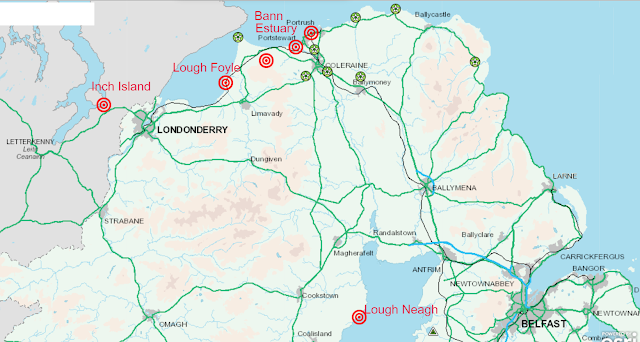
Activity was focused once again on the Inch Island Wildfowl Reserve in County Donegal for the Sandwich Tern colour ringing project, the Bann Estuary for breeding/migrating/wintering passerines, Lough Foyle for waders and winter farmland birds, Lough Neagh for breeding/migrating warblers, and the new upland site, referenced in the post below, for breeding birds. I have also marked Portmore Lough below (triangle to the east of Lough Neagh) which will be the site of a trail Constant Effort Site (CES) led by Steve in 2022. 

A total of 1549 birds were ringed of 51 species and a further 105 birds retrapped or controlled. 


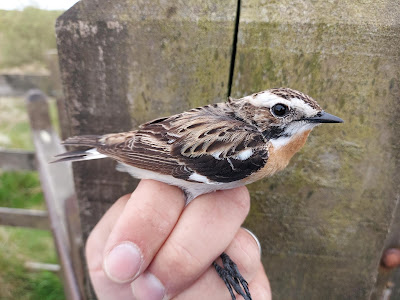
There were no rare or scarce birds ringed at the migration sites but the two Whinchats were a new species for the group. 


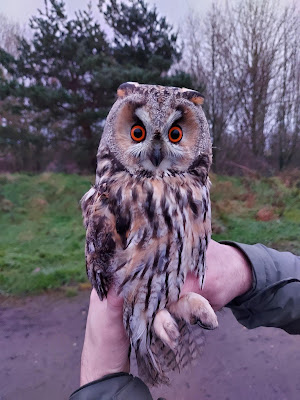
We were able to get out to the local woods to locate multiple pairs of breeding Long-eared Owls but did not have any opportunities to ring them. One Long-eared Owl did make an appearance at our farmland bird site on the shores of Lough Foyle. No sign of any of the local Barn Owls just yet though.

Spotted Flycatcher was another that we seldom ring, and this one was caught randomly on an upland bog, presumably on passage. 
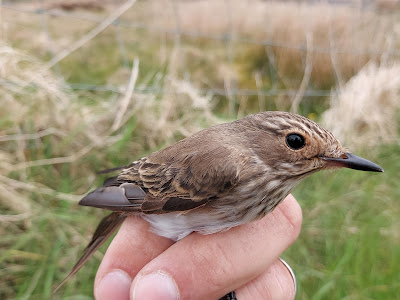

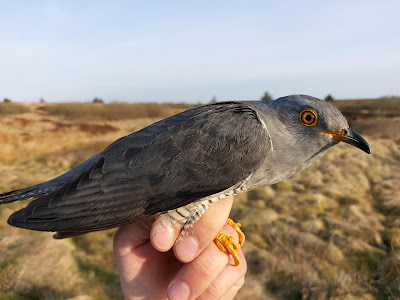
The upland bog site produced a nice range of breeding birds including the Whinchats, Spotted Flycatcher, Jay and two Cuckoos. A Red Grouse managed to escape the mist net it bounced into and would have been a very rare catch. 

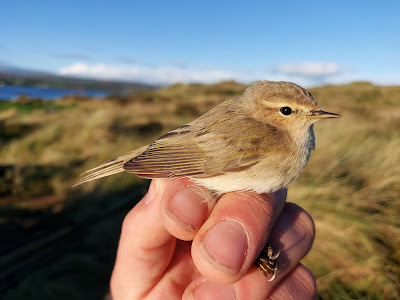
This putative Siberian Chiffchaff (Phylloscopus collybita tristis) trapped in October at Portstewart Strand should also be a new sub-species for the group and we are awaiting the DNA sequencing to confirm or otherwise. 

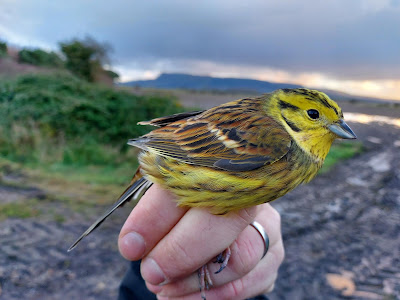
Farmland bird numbers were low, having missed any ringing from Jan-Apr, but four Yellowhammers at the end of the year added a splash of colour. There were also five plus Bramblings present at the site but none caught. 


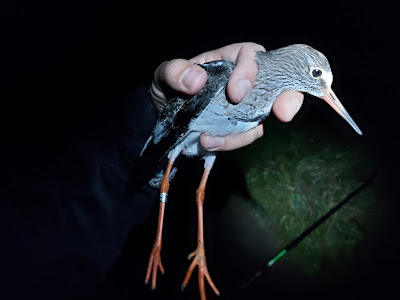
Wader ringing was very limited with one attempt lamping at both Lough Foyle and the Bann Estuary producing just eight Dunlin and eight Redshank. This will undoubtedly be improved in 2022.
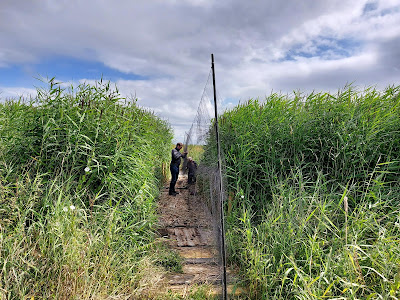
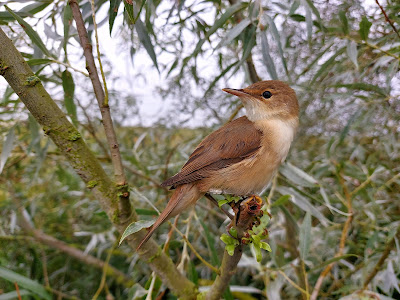
The reedbeds along the west shore of Lough Neagh were again very productive with 552 new birds across five sessions, including 365 Sedge and 86 Reed Warblers. Recoveries included a Blackcap to County Roscommon 3 years later, a Sedge Warbler to Wales, one Sedge from Dorset and two local movements along the Lough Neagh shore. 

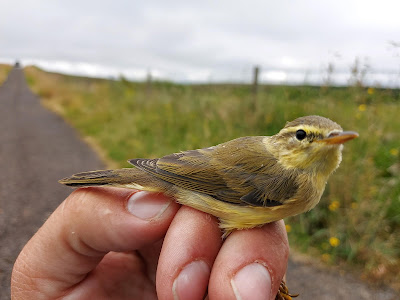
It was our third best year for Willow Warblers with 73 new, thanks to the 41 ringed at the upland bog. This will hopefully increase our chances of our first recovery of this species 

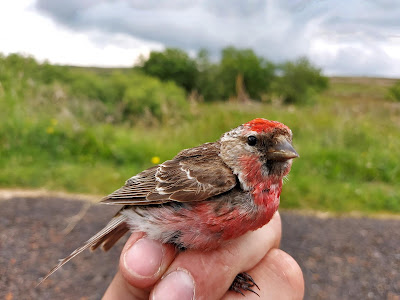
We haven't caught many Lesser Redpolls in recent years in the absence of garden feeder ringing so the 40 caught at the upland bog boosted numbers. A Dutch redpoll ringed in October 2020 at Heisteeg, Tilburg, Noord-Brabant, was a nice catch. A second recovery was also received from Yorkshire, England, originally ringed in November 2020. 

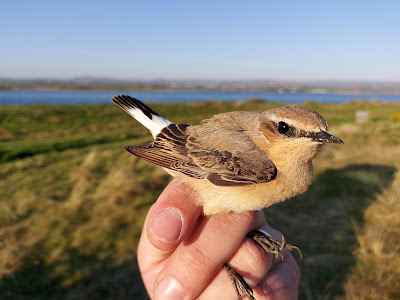
Four Wheatears were nice, all caught in mist nests in scrub. Three of these were Greenland Wheatears (Oenanthe oenanthe leucorhoa). The four matches the total in 2014 (4 pulli) and just the 9th-12th ringed by the group. 

Ken continued his nest box studies on Blue and Great Tits, although now studying around 10% of his former very large project at the Ulster University campus. Just two visits were made to catch Storm Petrels near Portstewart with 48 caught in total. 

Further recoveries included a Sedge Warbler and Sand Martin to the Loire-Atlantique area of western France and some more UK & Ireland Storm Petrel movements. The colour ringed Sandwich Terns were again appearing in the UK and South Africa and will be covered at another time. There were plenty of colour ring sightings including Ringed Plover, Oystercatcher, Black-headed Gull, Lesser Black-backed Gull, Herring Gull, Sandwich Tern, Whooper Swan and Brent Goose - I may cover our recoveries in another post which now top 400. 

A very quick round up of the year but hopefully the updates will be a little more forthcoming in 2022.


Wednesday, 21 November 2018

2018 Season at Portstewart Strand

As you can see, my slacking in regards to posts has really gone to a new level! I would put this down mostly to the fact that we haven't been as active and for 95% of the time it has just myself and John Clarke. I have also become slightly addicted to Twitter and post most of my stuff on there - you can find me at @causewaybirds - https://twitter.com/CausewayBirds

I'll try and play catch up  on our activities and recoveries through the season so far but I can't promise it won't be another few months before the next post 😛

So another season complete in the dunes of Portstewart Strand along the Bann Estuary on the north coast and the declining picture continues.

It was a disappointing spring with only 74 new birds from 8 visits and just two visits in the summer. As usual, we were more active in the autumn and finished with 401 new birds of 27 species in total. We trapped two new species for the site with a fantastic Cuckoo and Twite.

Cuckoo

It was also very quiet on the trainee and visiting ringer front with just one T ringer on one of the 21 visits and no C permit holders. It was myself and John Clarke for 13 visits, Ken present two and eight were solo.

Twite

The focus of our activities have been centred on the Sea Buckthorn scrub, but as a none-native species and because of it's negative impact upon the SAC, it is being removed bit by bit each winter (as are the net rides with 190m+ lost already and a continual process of creating new ones), with 5 acres lost last winter. A further 9 acres is to be removed this winter leaving us with just c2 acres and a few other small areas to work with & bird numbers will continue to slide.


Species                           New (retrap/local recovery)
1 Blackbird                      25 (3)
2 Blackcap                       19 (4)
3 Bullfinch                       13 (7)
4 Blue Tit                         10 (3)
5 Chaffinch                      23 (4)
6 Chiffchaff                      3
7 Cuckoo                          1
8 Dunnock                       15 (15)
9 Goldcrest                      10 (7)
10 Goldfinch                    12
11 Great Tit                     10 (1)
12 Lesser Redpoll            10
13 Linnet                          54
14 Meadow Pipit              80
15 Reed Bunting              14 (2)
16 Robin                          22 (8)
17 Sedge Warbler             1
18 Skylark                         6
19 Song Thrush               15 (1)
20 Sparrowhawk               1
21 Starling                        1
22 Stonechat                   11 (2)
23 Twite                           1
24 Whitethroat                  2
25 Willow Warbler           14 (5)
26 Woodpigeon                2
27 Wren                           26 (15)
Total                                 401 (77)


Perhaps not the easiest to read, but see below for the totals from the site since we began ringing at Portstewart Strand in the autumn of 2014. The right-hand box indicates the effort put in each year and as you can see it was our worst yet for a full season

There were no recoveries of any great distance with just a few local movements to/from the Ulster University Campus & Castlerock.

The weather in recent weeks has been very poor so we haven't opened any nets but hoping to shift our attentions over to Castlerock for the remainder of the year.

The next post will cover our return to the Lough Neagh shore and promises lots of acro warblers including three controls/recoveries including two to France and our first Reed Warbler control!

Skylark

Wednesday, 27 May 2015

Springwell Forest 27/05/2015 + Dippers

Todays visit to Springwell Forest was to attempt to catch the 3 Cuckoos spotted by John and Ken earlier in the week.  The three of us were on site for 7am and set a couple of nets along a track through low scrub, with a decoy Cuckoo and tape lure (with endorsement).  The weather was overcast and a little breezy.

                        Sedge Warbler               © JC

On arrival we were greeted to the sound of lots of Warblers with Grasshopper, Sedge and Willow Warbler plus some Whitethroat amongst the regenerating conifer plantations full of Willows.  Whilst waiting for a Cuckoo to show up, we put up 2 low nets at the edge of scrub.  This proved worthwhile with a nice Grasshopper Warbler and Sedge Warbler, although we didn't catch any of the smart male Whitethroats singing above the nets.   

                     Grasshopper Warbler               © JC
 

There were also plenty of other birds about with a flock of 12 Crossbill, 1 Kestrel, 1 Buzzard, 2 Stonechat, 4 Jay, 1 Spotted Flycatcher, 3 Grey Wagtail, Lesser Redpoll, Siskin and a Dipper.  The Dipper seemed strange at the time, flying across forestry scrub but we later found a nest with 4 chicks (which we ringed) under a culvert on a small stream. 


                       Dipper pullus                 © JC

Two male Cuckoos appeared and spent a while flying around the nets and calling back to the tape but unfortunately, as with previous attempts, we didn't manage to get any birds in the nets.  The nets were a little exposed to the wind but we may have another attempt soon. 

Cuckoo


   Ringing Totals 27/05/2015

                                        New        Pullus
Dipper                                                4
Grasshopper Warbler       1
Robin                                1
Sedge Warbler                  1
Song Thrush                     1
Willow Warbler                 2
Wren                                1                                                        

Total                                7               4              
 
 
Earlier in the breeding season Ken had been busy studying the growth rates of Dipper chicks between lowland and upland areas.  This involved locating nests (also with 17 nest boxes) and visiting daily to time the laying of the eggs and hatching.  Once the study nests had been selected the chicks were weighed everyday until fledging.  We will share the results in due course. 


The photos above are the copyright of Ken Perry

Wednesday, 13 May 2015

Portstewart Strand 13/05/2015

The conditions this morning were near perfect (calm/dry/dull), although the light winds were of the northerly kind.  I was on site from 05.30 and set East ride, the gorse nets and the first 18 metre net of West ride (the best net), departing the site at 11.00. 

  Bullfinch

The site seemed quiet early on with the only noticeable difference being more singing Blackcaps.  As the morning went on things picked up a little with a couple of Swifts flying over, 7 Whimbrel on the estuary and a short appearance of a male Cuckoo late morning.  The first couple of Sedge Warblers started singing around 10am and there are at least four territories, although they are in the open scrub away from the nets rides.  One of the local Otters is out everyday at the moment and spends most of the morning fishing in the open, giving some great views. 

Song Thrush

The catch started well with 18 of the birds processed before 8am, 9 of those coming in the first round.  It slowed down after that finishing with 27 birds processed, of which, 16 were new.  The site is pretty prolific for Bullfinches with the new bird today taking the total to 28 since the 16th of September.  I also caught another smart male Reed Bunting today, which shows an even more complete black hood, compared to last weeks. 


Reed Bunting


Ringing Totals 13/05/2015
 
                                        New         Retrap
 
Blackbird                          2                 3
Blackcap                           2
Bullfinch                           1                 1                 
Chaffinch                          1
Dunnock                           1                 1
Goldfinch                          2                                      
Linnet                                                   1
Meadow Pipit                   1
Reed Bunting                   1                
Song Thrush                     1                                                                              
Willow Warbler                 3                  2                  
Wren                                1                  3             

Total                              16                 11                


In terms of the patch year list I have added three new species over recent days.  I picked up my first Swift on the 11th, a Merlin on the 12th and then todays Cuckoo.  The later two are both new species to the patch for me. 

Steve and I are heading back over to Copeland Bird Observatory this weekend and again full of optimism - a Spotted Flycatcher would be nice!  The forecast is once again looking windy and wet at times but the Island often gets better weather than the mainland, so fingers crossed.  It will be my first trip as ringing duty officer, so a new species would be a nice way to mark the occasion.