Showing posts with label Long-eared Owl. Show all posts

Monday, 7 February 2022

2021 Season and Ringing Totals

Despite the inactivity on the blog, the nets were up and open with regularity throughout the autumn and into early winter. Covid restrictions had an impact on the early season ringing and have resulted in lower totals, as below. There have also some changes to the group with John Clarke retiring from ringing after c20 years and Ken taking a temporary step back, but keen to continue again in 2022. On the plus side, Dean Jones has returned to the North Coast following a number of years working as the Warden on Lundy Island, Devon, where he was observing the likes of the Sulphur-bellied Warbler and ringing Wrynecks, Subalpine Warblers etc; birds which we can only dream of up here. David Stirling has achieved his C permit and the two are now set up with their own equipment and rings and ready for action. Steve Fyffe has advanced to his A/Supervisor permit. I have put the ringing on ice so far this year following the birth of my first child in mid-January but I hope to get back into action in spring, although at a reduced level. 

Regular updates continue on Twitter @CausewayBirds. 

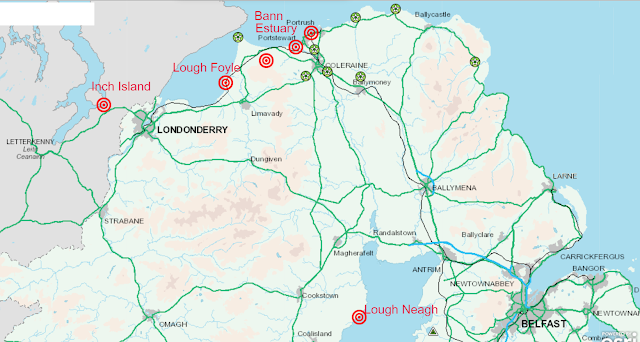
Activity was focused once again on the Inch Island Wildfowl Reserve in County Donegal for the Sandwich Tern colour ringing project, the Bann Estuary for breeding/migrating/wintering passerines, Lough Foyle for waders and winter farmland birds, Lough Neagh for breeding/migrating warblers, and the new upland site, referenced in the post below, for breeding birds. I have also marked Portmore Lough below (triangle to the east of Lough Neagh) which will be the site of a trail Constant Effort Site (CES) led by Steve in 2022. 

A total of 1549 birds were ringed of 51 species and a further 105 birds retrapped or controlled. 


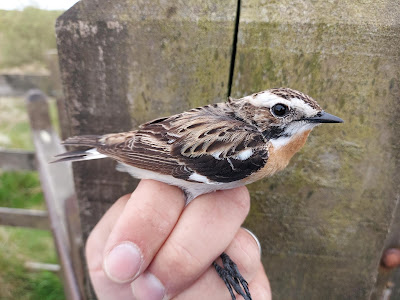
There were no rare or scarce birds ringed at the migration sites but the two Whinchats were a new species for the group. 


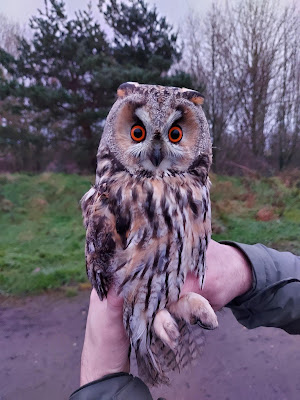
We were able to get out to the local woods to locate multiple pairs of breeding Long-eared Owls but did not have any opportunities to ring them. One Long-eared Owl did make an appearance at our farmland bird site on the shores of Lough Foyle. No sign of any of the local Barn Owls just yet though.

Spotted Flycatcher was another that we seldom ring, and this one was caught randomly on an upland bog, presumably on passage. 
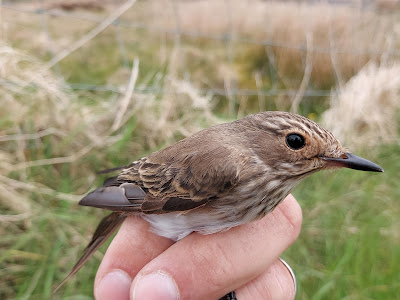

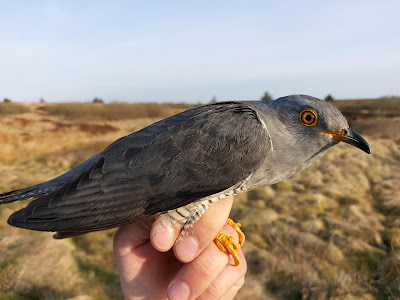
The upland bog site produced a nice range of breeding birds including the Whinchats, Spotted Flycatcher, Jay and two Cuckoos. A Red Grouse managed to escape the mist net it bounced into and would have been a very rare catch. 

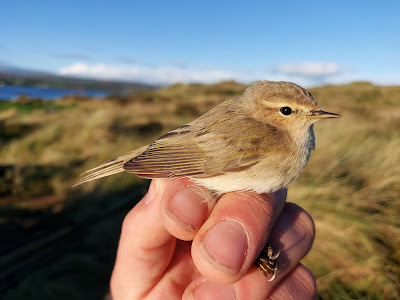
This putative Siberian Chiffchaff (Phylloscopus collybita tristis) trapped in October at Portstewart Strand should also be a new sub-species for the group and we are awaiting the DNA sequencing to confirm or otherwise. 

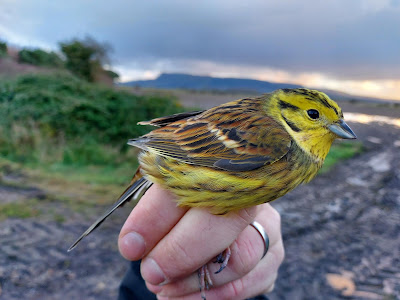
Farmland bird numbers were low, having missed any ringing from Jan-Apr, but four Yellowhammers at the end of the year added a splash of colour. There were also five plus Bramblings present at the site but none caught. 


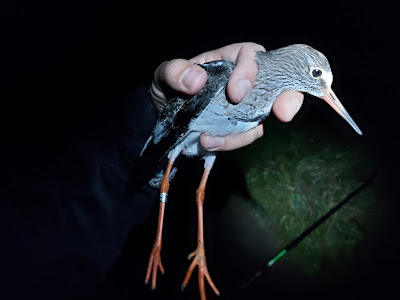
Wader ringing was very limited with one attempt lamping at both Lough Foyle and the Bann Estuary producing just eight Dunlin and eight Redshank. This will undoubtedly be improved in 2022.
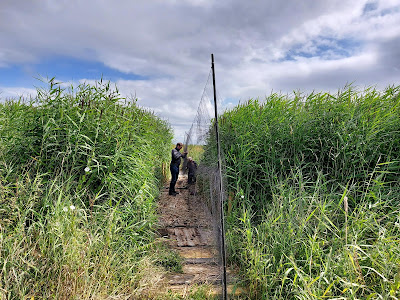
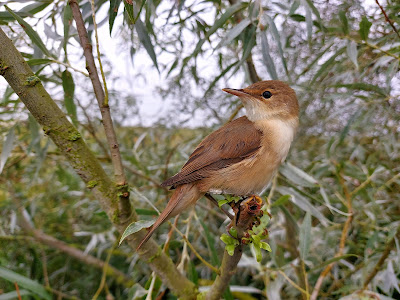
The reedbeds along the west shore of Lough Neagh were again very productive with 552 new birds across five sessions, including 365 Sedge and 86 Reed Warblers. Recoveries included a Blackcap to County Roscommon 3 years later, a Sedge Warbler to Wales, one Sedge from Dorset and two local movements along the Lough Neagh shore. 

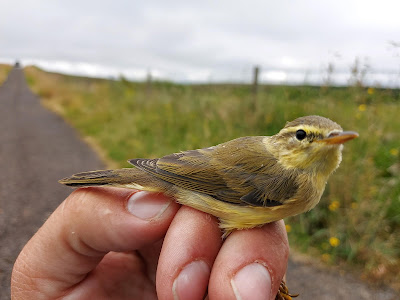
It was our third best year for Willow Warblers with 73 new, thanks to the 41 ringed at the upland bog. This will hopefully increase our chances of our first recovery of this species 

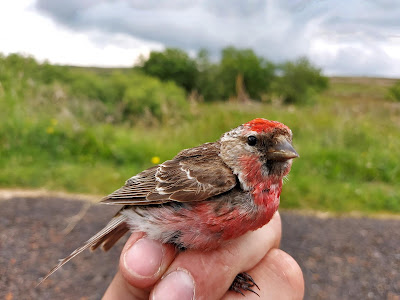
We haven't caught many Lesser Redpolls in recent years in the absence of garden feeder ringing so the 40 caught at the upland bog boosted numbers. A Dutch redpoll ringed in October 2020 at Heisteeg, Tilburg, Noord-Brabant, was a nice catch. A second recovery was also received from Yorkshire, England, originally ringed in November 2020. 

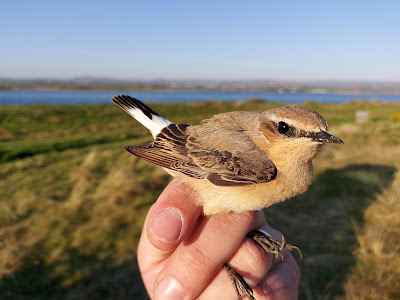
Four Wheatears were nice, all caught in mist nests in scrub. Three of these were Greenland Wheatears (Oenanthe oenanthe leucorhoa). The four matches the total in 2014 (4 pulli) and just the 9th-12th ringed by the group. 

Ken continued his nest box studies on Blue and Great Tits, although now studying around 10% of his former very large project at the Ulster University campus. Just two visits were made to catch Storm Petrels near Portstewart with 48 caught in total. 

Further recoveries included a Sedge Warbler and Sand Martin to the Loire-Atlantique area of western France and some more UK & Ireland Storm Petrel movements. The colour ringed Sandwich Terns were again appearing in the UK and South Africa and will be covered at another time. There were plenty of colour ring sightings including Ringed Plover, Oystercatcher, Black-headed Gull, Lesser Black-backed Gull, Herring Gull, Sandwich Tern, Whooper Swan and Brent Goose - I may cover our recoveries in another post which now top 400. 

A very quick round up of the year but hopefully the updates will be a little more forthcoming in 2022.


Sunday, 6 January 2019

Other Ringing and Recoveries

I updated on our ringing activities since early summer at both Portstewart Strand and Lough Neagh in previous posts but we weren't just limited to those sites. Through this time we continued our summer Storm Petrel ringing, seven/eight trips to Copeland Bird Observatory between us and a few other bits a pieces.

There was another new species for the group in Grey Heron caught by Ken and James on the 9th of June. Usually when river ringing we are fearful of these massive brutes blundering into the nets and ripping them to shreds but on this occasion it stuck with out any damage to the bird or net and was extracted quickly. Handling Grey Herons is a two man job so no pictures were taken.

One of the nicest birds in this time was this stunner of a Long-eared Owl caught at the University campus in Coleraine by John and Ken on the 4th of July.
Long-eared Owl

We had our first Long-eared Owl recovery but in unfortunate circumstances. One of the chicks ringed at the University campus back in 2011 (pictured below) was hit by a car on the 13th of June this year around 9.5 miles away near the town of Ballymoney. Although sad circumstances, it is interesting to see the dispersals of the birds.

The Storm Petrel season was a poor one yet again and it really is on a downward trend and so to is effort because of it. This year it was just the three visits with catches of 5, 16 & a control and 17 & a Redshank.


As well as our control, we had two birds recovered making it a hat-rick of bird observatories.

The controlled Storm Petrel was ringed at North Ronaldsay Bird Observatory, Orkney, Scotland on the 2nd of August 2018 and controlled by us 18 days later at Rinnagree Point at a distance of 529km.
North Ron is one of those enviable observatories that see and catch what we would deem rare by the bucket load - check their blog out here - http://northronbirdobs.blogspot.com/

A Storm Petrel ringed by us Rinnagree Point on the 17th July 2017 was caught at Skokholm Bird Observatory, Pembrokeshire, Wales on the 11th August 2018.  398 km distance and 390 days.
Skokholm, like North Ron, makes us very jealous and we'd love just a fraction of their birds! Visit their blog  - https://skokholm.blogspot.com/

The final bird was one of our 2016 birds ringed on the 1st of August which was retrapped at the Calf of Man Bird Observatory on the 9th of June this year. We have never caught a bird before the 1st of July so perhaps these guys have picked up breeder (which arrive earlier) on route to its breeding site. I'm not sure if they breed on the Calf again yet after the recent eradication of rats. 174km distance and 677 days.
You can keep up to date with these guys on Facebook - 
https://www.facebook.com/calfofmanbirdobservatory/

Storm Petrel Movements

I haven't updated the Storm Petrel control maps or info in a while but you can click on the tabs above to check out all the other movements.


This control isn't particularly impressive but considering I just caught my first Greenfinch retrap a few weeks ago, it is nice to see where they go. The said bird was ringed at Castlerock on the 7th of Jan 2018 and found dead by a member of the public 4km away in Articlave on the 15th of May 2018, dead within a week. It was presumably breeding along the local hedgerows which are quite good and hold a population of Yellowhammers, the only decent one I'm aware of in the wider area.

Back in March I updated about the ringing in Kens garden and the good numbers of Siskins and a brilliant control all the way from Cape Clear Bird Observatory 454 km at the very south of Ireland. (http://causewaycoastrg.blogspot.com/2018/03/siskins-and-garden-ringing.html) The Siskins continued to visit and 78 new birds were captured. One of these birds itself was then controlled elsewhere making its way to Salsburgh, North Lanarkshire, Scotland. It was originally ringed on the 13th of March and recaptured on the 6th of May - 54 days apart, 193km away. This is the second of our Siskins that has been controlled at this same site following one from my parents garden in the Loughan a few years back.

Siskin to North Lanarkshire 


I've finished with a picture of the Portstewart Strand Cuckoo just because its a stonker bird!

Saturday, 4 June 2016

Summer Season - Terns, Gulls and Nest Boxes

John hosted two trainees at the University River Site on Bank Holiday Monday.  The conditions started off overcast but the cloud soon burnt off leaving a hot sunny morning.  They had a decent session, catching the first fledged birds of the year in the form of two Robins.  Two Sedge Warblers were also a nice catch as they don't breed that often at the site and we usually only manage half a dozen each year in total.

Sedge Warbler

River Site 30/05/2016                                 

                                   New       Retraps          
Blackbird                    1                                                                                 
Bullfinch                     2                1               
Dunnock                     1                1              
Lesser Redpoll           1
Robin                          2                1                
Sedge Warbler           2     
Song Thrush                                 1
Willow Warbler          2                 1 
                   
Total                          11                5             


Ken and a team of five (three from the National Parks and Wildlife Service) made the first follow up ringing trip to Inch Wildfowl Reserve in Donegal on Tuesday, following the initial visit back on the 10th of May to gauge the number of nests, eggs etc.
The team  had a successful day and ringed 180 Sandwich Tern chicks, which is only 9 birds shy of last years total with the second visit to come in a week or so.  There had been around 400 eggs counted on the first visit so, all being well, there should be many more fledged birds on the final visit.  They also managed to ring 43 larger Black-headed Gull chicks.  Andrew took the opportunity to count the Common Tern nests and found 57, the majority with 3 eggs.  If the fantastic weather and lower water levels continue and the local predators stay at bay, we could be set for one of the best years for the Common Terns.  The most productive year at Inch was back in 1999 with 86 chicks ringed.

For some videos of the trip check out the Inch Wildfowl Reserve on Facebook -  https://www.facebook.com/inchandfoyle/


Over the long weekend I managed to get around the rest of the general nest boxes scattered around the estuary and in Castleroe Wood.  The boxes in the estuary haven't had a great uptake with just one pair of Blue Tits at each of three.  I did manage to get at least one pair of Tree Sparrows with eggs and a second partially complete nest.  It is a decent start for the target species and they will hopefully use the boxes further and increase. 
Castleroe Wood has improved on the dismal year in 2015 when only 27% of the boxes were occupied.  So far this year it looks liked c40% are occupied, which is still down on the norm of c75% in the wood.  I ringed 24 Great Tit chicks, 3 adult females plus two adult female Blue Tits on this visit.  The Blue Tits are well behind, mostly still at the egg stage but they should be ready for ringing this weekend.  I did find 4/5 Spotted Flycatcher territories around the wood, 3 with vacant open faced boxes but no interest in them as yet.     

Blue Tit

Ken also checked his boxes back on the 26th of May in the University campus and ringed 39 Blue and Great Tit chicks.  This scheme is part of a study on the preference of tree species for nesting, comparing c30 species, so it will be interesting to hear the initial results from year one! 

John has been keeping an eye on an accessible Long-eared owl nest in the University campus over the past few weeks but we have missed the opportunity and the chick has fledged already.  It is still nice to see the birds in such close proximity and that they continue to fledge young every year. 

Long-eared Owls by John Clarke


I have received news of one of the colour ringed Black-tailed Godwits and of a local movement of a Meadow Pipit, so I'll try and update on those next time!


Thursday, 28 April 2016

Copeland Bird Observatory 22-24 April

Steve and I headed out to Copeland Bird Observatory for our first visit of the season along with three others.  The forecast had put the trip in doubt with the strong northerly winds potentially making the crossing dangerous but thankfully it went ahead, with just a bit rock and bounce on the way over.  The cold strong arctic winds suggested that there would be very little on the move, so we weren't expecting much bird wise.  The forecast did prove true and we had strong winds throughout with just two quieter spells early on Saturday and Sunday mornings but at least it stayed sunny!

Sunrise over Mew Island

We were pleasantly surprised with the birds on offer with one of the first birds spotted being a Long-eared Owl, which scared the life out of Steve as it flushed from the bracken as he walked past.  The LEO resurfaced the next morning around 30 seconds after a ringtail Hen Harrier floated past.  A total of 52 species were recorded with corvids being the main movers with c80 Hooded Crows, 5 Carrion Crow, c18 Jackdaw, 1 Rook and the resident pair of Ravens and Magpies.  Passerine migrants were slim on the ground with a couple of Willow Warblers, a quick sighting of a Wheatear, a Song Thrush, a few Swallows, Sand Martins and House Martins plus a few Meadow Pipits and some mixed finches in Lesser Redpoll, Linnet and GoldfinchSandwich Tern, mixed auks and Whimbrel were the only obvious migrants at sea.  

Jackdaw

With the winds coming from the north/north west, we focused the nets on the more sheltered east and south of the island and used the four Heligoland traps and the Crow Trap.  We got up at 05.30 on both Saturday and Sunday mornings and opened up the nets and traps with the first birds hitting the nets after 7am. 

Rock Pipit

Catching was pretty slow and died off around 10am.  The best bit of action was the capture of 6 Linnets together in the Gully Trap, although another 6 managed to fly out the front on approach.  The second British Goldfinch control in as many weeks at the Obs was nice and will probably be birds ringed in the last year because they were both Z sequences. 

CBO ringing totals 23-24/04/2016

                                  New       Retraps          
Blackbird                                    4                                                  
Goldfinch                    7              1 (control)                                                                     
Jackdaw                      1
Lesser Redpoll           3             
Linnet                          8                               
Reed Bunting             2               2                          
Robin                                           1
Rock Pipit                   2               1
Song Thrush              1
Willow Warbler          2                
Wren                                            1
                   
Total                          26              10          


The breeding season on the island has begun with the first Greylag goslings out, the Herring/Lesser black-backed Gulls on eggs, Jackdaws nesting in the buildings, a hatched Woodpigeon egg and a Swallow seen collecting mud.  The other birds have paired up, such as the Black Guillemots, Eiders and Reed Buntings plus the first couple of Puffins have been sitting on the water below the new colony.   

One of 35 odd pairs of Black Guillemots on the Observatory Island

Our next trip is planned for the weekend of the 13th to 15th of May, so hopefully the weather is a little kinder.  There are still places left over the coming months if anyone would like to stay at the observatory, plus a number of day trips coming up - check out http://www.thecbo.org.uk/ or https://www.facebook.com/copelandbirdobservatory/?fref=ts for more information.   


On Friday morning Ken and Tyrone held a ringing session in Kens garden and caught a very nice mix of 14 different species, including the first Blackcaps of the year.  The weather was sunny, calm and pleasantly warm.  The nets were focused around the feeders with an extra net set on the woodland edge.

Willow Warbler

The feeders are still attracting a number of finches including Chaffinch, Goldfinch and Lesser Redpoll and boosted the number of birds caught.  The exterior net also helped catch species not often caught around the feeders including the Goldcrest and Willow Warbler.  A total of 38 birds were processed and show a mix of general winter and summer birds. 

Kens Garden  22/04/2016                                  
                                  Processed            
Blackcap                          3
Blue Tit                            2
Chaffinch                         8
Coal Tit                            1
Dunnock                           2                                                                  
Goldcrest                          1
Goldfinch                         5                                                                      
Great Tit                           2
House Sparrow                1
Lesser Redpoll                 5            
Long-tailed Tit                 4                           
Robin                               1                      
Willow Warbler                1          
Wren                                2  
                   
Total                               38                 


John had a quieter session at the River Site on Saturday morning with a handful of birds but he also caught his first Blackcap of the year and caught a returning Willow Warbler that had been ringed at the site in the previous year. 

Tuesday, 19 January 2016

Irish Bird Ringing Data - Owls

In Ireland we generally have three breeding species of Owl - Barn, Long-eared, Short-eared Owls and have had a couple of rare visitors in Little, Scops and Snowy Owls.   Little Owl is the only species not to have been ringed and the minimal records may have been as a result of a failed, non official, introduction.
A single Scops Owl was ringed in Ireland in 1999 at Cape Clear - a further 8 have been ringed in Britain since 1909. 
The Snowy Owl is a rare winter visitor to Ireland, although the odd bird has taken up residence out west and they have even attempted to breed.  The data is a little unclear as there are suggestions that there were four pullus ringed in 2002 but the BTO don't seem to have a record of this.  A pair was confirmed to have attempted breeding in 2001 but failed with four eggs, so the potential is there, but unlikely.  There was certainly one adult male Snowy Owl ringed in 2002.  A total of 29 have been ringed in Britain since 1909, although the majority of these were nestlings from the breeding pair in Shetland between 1967 and 1975.     


Barn Owl

Across much of Ireland the Barn Owl is a scarce breeder with the greatest concentrations in the southwest.  There are as few as 40-50 pairs across the whole of Northern Ireland.

A total of 670 Barn Owls were ringed in Ireland since 1977 and you can see from the graph below that it is in the past eight years when the majority were caught.  This data is not representative of populations but is down to the real effort made by the guys in Duhallow (more info below) and also the erection of hundreds of owl boxes.  Of those birds ringed, only two were caught in Northern Ireland.  A further two were ringed in 2015 when Barn Owls bred in an owl box in Northern Ireland for the first time.  Many more boxes have been going up in suitable locations in the past few years and it is hoped these will help boost the breeding populations.  There's nothing much we can do with the wet & windy Irish climate and the lack of voles but we could improve the habitats and cut back on poisons/toxins.   


Ringing recoveries show a main movement of birds from southwest Scotland, with four birds ringed as nestlings in Dumfries and Galloway relocating to Ireland.  The Welsh bird from Anglesey was also ringed as a nestling.  The bird ringed on the Yorkshire coast is interesting because it was a first year bird when it was trapped in mid September, although there are no details in regards to race.  The European race 'Dark-breasted' Barn Owl (Tyto alba guttata) has been recorded in Ireland but long distance Barn Owl migration still remains a rare occurrence across the world. 
All of the recoveries have been in relation to dead birds with four road casualties, one hit by a plane and one long-dead in a derelict building. 


Barn Owl movements into Ireland


The guys in Duhallow have been doing some great work on Barn Owls and other raptors in recent years and probably account for the majority of Barn Owls ringed in Ireland - check out these blogs for more info...


Long-eared Owl

                           Long-eared Owl                            (JC)

 
LEO is the most common and widespread Owl in Ireland but is seldom seen because of its inconspicuous nocturnal nature.  The numbers are boosted in winter when there is an arrival of birds from the north/east.
Since 1975, 151 LEO have been ringed in Ireland with at least 50 of those ringed in the north.  Before this period there were five ringed at Copeland BO & two at Cape Clear BO.  There are no obvious trends in the catch graph, but like Barn Owl, this will be down to effort by ringers.  Adult LEOs are quite difficult to catch and many of the records of these refer to birds caught at the coastal sites on migration.  The majority of the records are pulli ringed in nests and with clutch sizes up to six eggs, it can really increase the number caught in one year.


The recoveries of Long-eared Owl into Ireland are rather few but they do show a nice range of the movements.  The first of these comes as a passage migrant from Helgoland, Germany, which could have potentially come from anywhere but most likely out of Scandinavia via Denmark.  The second bird came through Orkney and probably made the jump from Norway.  Both these birds were caught in subsequent years after initial ringing, so possibly could have migrated multiple times but it is difficult to say.  The third bird was ringed in a nest in central Scotland and was recovered in its first winter. 
The only movement out of Ireland was a bird ringed as a chick in Phoenix Park in Dublin, which was controlled at the Calf of Man Bird Observatory.  It is perhaps not a movement you would expect, with the bird heading north east in November in its second year. 


Long-eared Owls movements into and out of Ireland


Short-eared Owl


The SEO is generally a winter migrant to Ireland, with birds from Scandinavia and Scotland. One or two pairs breed every other year in some of the upland areas.  The Antrim Hills have been a relatively reliable area since 1997.  The success is said to be down to the accidental introduction of Field Voles into the area via bags of conifer saplings, brought over by a Scottish forestry company.  The proximity to the breeding birds in Dumfries and Galloway and the Scottish Borders probably boosts the Irish breeding population.
During the period of 1977 to 2014 there were only 10 SEOs ringed in Ireland, all in the south, plus at least one ringed in 1965 and at least one caught in late 2015 - more information on this bird is available below
 http://midwalesringers.blogspot.co.uk/2015/11/irish-aa-in-red.html


Like the LEO, there are only three records (available to me at least) of birds moving into Ireland.  The only foreign recovery was a bird from Ikaalinen, Turku-Pori, Finland in an impressive movement of at least 2311 km.  This bird was ringed as nestling in June 1988 and recovered dead the following April in southwest Cork.  The other two birds were ringed as chicks in central Scotland and both headed to Ireland in their first winter, and as with most owls, were found dead, unfortunately the bird in Wexford was shot.  It would be quite interesting to know where Irish born SEOs go...


Short-eared Owls movements into Ireland


Potentially there were five Snowy Owls in 2002 but I can only confirm one, so I am being cautious and including just the single bird.