Showing posts with label Long-tailed Tit. Show all posts

Sunday, 19 November 2017

Copeland Bird Obs Winter Training - November 2017

I've been slacking once again and not updated the blog in a month but we have been a little idle over the past three/four weeks down to weekend weather and lack of free time. My last time out, until today, was back on the 27th of October at Portstewart Strand, so we really missed out on the thrush passage.

This morning Steve, David and I were up in Antrim for the first Copeland Bird Observatory training session of the winter. We ring here once a month Nov-Mar outside the Obs season to give the trainees a little more experience and to handle some new species. We had a good mix of 5 trainees, 3 C and 3 A permit holders.
The feeding station was really quiet with not a Goldfinch in sight and very few thrushes but we still processed over 100 birds.
The wild bird seed plot produced half the haul from two well placed nets.
The best bird of the morning was the first Blackcap for the site and 28 new Linnets is a great catch.


Blackcap

Antrim Ringing Totals - 19/11/2017
                  
                             New       Retraps
Blackcap                1
Blue Tit                  6              2
Chaffinch              17             5
Coal Tit                  4              1
Dunnock                2              1
Goldcrest               8
Great Tit                 1               2
Lesser Redpoll      5
Linnet                    28              1
Long-tailed Tit      10
Robin                     7
Wren                      3


Totals                   92              12        


Initial signs are that it was a bad year for Blue and Great Tits. This time last year we caught 14 Greti but just one juvenile today. The Blue Tit catch was also low and only 3 of the 8 were juveniles. There were a few Blackbirds around but not feeding on the fruit trees just yet. We caught 27 new Blackbirds in the first two visits of last winter. A cold snap and a touch of frost would help the next catch!

Long-tailed Tits


Although we had planned to carry on at Portstewart Strand for a few more visits, it turns out that the 27th of October was the final visit of the season. I was down by myself in mild sunny conditions with some light northerlies. As I sit now I don't remember all that much about the day but I did catch 34 new birds. The total was heavily boosted by Linnets with 17 new birds.


Portstewart Strand 27/10/2017                            
                             New         Retrap
Blackbird               2                        
Blue Tit                  1      
Bullfinch                2                2
Chaffinch               4
Goldcrest               2                2 

Goldfinch               1
Great Tit                 1      
Dunnock                                  1  
Linnet                    17
  
Robin                                       1         
Song Thrush         1

Wren                      3

Totals                    34              6         

Bullfinch

John was out on the 2nd  of November at the University River Site and over a few hours caught 23 new birds including 12 Long-tailed Tits and a Blackcap.

We were all up at the BTO Northern Ireland Birdwatchers Conference last Saturday at Oxford Island and thoroughly enjoyed the range of talks with plenty of focus on ringing, migration and talks on Ireland's two bird observatories!

I will follow up with the end of season totals for Portstewart Strand in the next month or so. As for now it should be back to Castlerock but I have been saying that for a few weeks and not made it out the door! There has been no sign of the usual winter thrushes feeding on the Sea Buckthorn berries but it is early doors yet. I have prepared the net rides at Castlerock but other than that, we don't have any real plans for the winter and have yet to set up any feeders but will find other bits and pieces to keep us busy.

27m net ride at Castlerock

Monday, 7 December 2015

Irish Bird Ringing Data - Crests and Tits


Five species of Tit have been ringed in Ireland since 1975 and one of those I have included by name default - Bearded Tit (Reedling).  The other four are widespread breeders - Blue, Coal, Great and Long-tailed Tit.  The only other species of Tit recorded in Ireland that has not been ringed is Marsh Tit, following a short lived unofficial introduction of birds in a woodland in the south. 
Only two species of Crest have been ringed/recorded in Ireland - Goldcrest, a widespread breeder and Firecrest, an uncommon passage migrant.  A close relative from North America has also been recorded - Ruby-crowned Kinglet, with one being trapped at Cape Clear BO in 2013.  It is very rare in the Western Palearctic with only two previous records which came from Iceland in the 90's.  Given that only one RcK has been ringed, I won't go into any detail.


Firecrest

Firecrest are almost annual along the south coast on migration, but records have tailed off a bit in recent years.  2015 proved to be a very productive year with 40+ birds recorded between Sept-Nov.  The previous years were less so, with potentially just the one in 2014, 12 in 2013, three in 2012 and two in 2011.  Generally most of the records come in the Autumn but in the odd year, such as 2013, they came in the spring.  One or two birds will also winter in Ireland but these records are few and far between.  Firecrest is a rare bird in Northern Ireland.
The graph below shows a trend of greater encounters with birds through the 80's and early 90's with much fewer records since 2008, with only one record.  A total of 79 were ringed in this period in the south, with six in the north.  There were at least seven ringed in Ireland before this period but again I only have partial records for then.       


Goldcrest


The Goldcrest is a common breeder throughout Irelands forests and they are one of the few species who inhabit the dense coniferous plantations.  The majority of the birds are caught at coastal migration points and offshore islands in the spring and autumn.  They are typically short lived, averaging about two years, so the majority caught are first year birds.
There was a huge invasion this autumn, when Goldcrests hit Britain in their thousands, with perhaps 100+ bearing rings from Fennoscandia, Poland, Belgium, Holland, Denmark and the Baltic States.  Ireland didn't seem to feel the effects and ourselves (CCRG) on the north coast actually caught less than last year with increased effort!
Going by the graph below it would seem that these eruptions have happened before, particularly in 1989 when 1,825 were ringed, followed by the second most productive year of 1988 with 1,182.  There was probably association in these two years, with a good spring following a bountiful autumn.  2009 was the quietest year with only 91 caught across Ireland.
A total of 19,535 have been ringed in Ireland since 1975. 


The recovery map below shows a strong correlation of birds using the Irish Sea islands and the south coast of England but that is where the majority of the ringers assemble!  I am surprised that there is only a single record coming from the north, as I thought there would have been quite a few more.  Copeland Bird Observatory is a focal point but it is difficult to say if these birds are coming out of Ireland or if they are coming from Scandinavia/Scotland without more ringing records.  Certainly when the birds pass through/leave Ireland they all seem to move south/east, with all recoveries going to Britain, although the results may be biased as I discounted all inter-Ireland movements which may have shown otherwise. 

       Goldcrest recoveries - green in, red out


Bearded Tit

As of 2011, Bearded Tits returned to Ireland as a breeding bird after a 26 year absence.  They again bred in Co. Wexford in 2012 & 2013 and may have done so in 2014-15 but I do not have the data - there have certainly been birds present.  The species seems to come in small fluxes along the east coast, with birds recorded in Louth in 1966, Wicklow 1974-1985 (breeding proved in 1976 and 1982-1985) and further records in Wexford in 1989 and Cork 1979-81.
The only ringing to target the species took place in the early 80's and ceased when breeding was confirmed in 1985. 


Long-tailed Tit

A tiny resident breeder, that spends much of the year in family groups, often numbering over a dozen birds.  During ringing sessions, it is often the case that if you catch one or two of the family group, the rest will join them in the pockets of the mist nets, responding to their relatives calls. 
The numbers caught from year to year is very staggered with some striking differences.  The species notoriously does not fair well in prolonged cold spells and may go in some way to explain the changes but undoubtedly not the only reason.  The trends between north and south show the complete opposite at times and this suggests that ringing effort may be a major factor.
The greatest number ringed in one year was in 1975 with 383, with the lowest coming in 2001 with 72.  A total of 7,788 have been ringed in Ireland since 1975. 


In general most of our Tit species are rather sedentary and this is the reason that there are so few recoveries.  From the data available to me, I found only two movements in or out of Ireland. 
The first was a Great Tit ringed at Portmore Lough, Co. Antrim, that found its way to Greater Manchester four years later, unfortunately succumbing to a window.  The second was a fast moving Blue Tit that made its way from Bardsey Bird Observatory to Cape Clear Bird Observatory, covering 354 km in 18 days.  I also included two interesting inter-Ireland movements.  One was a Great Tit moving from Dublin to County Tyrone and the other was a Coal Tit moving 268m km from Cape Clear BO to County Offaly in the midlands - potentially an immigrant to Ireland. 

                                                     Tit recoveries - Green in, red out and blue inter


Great Tit


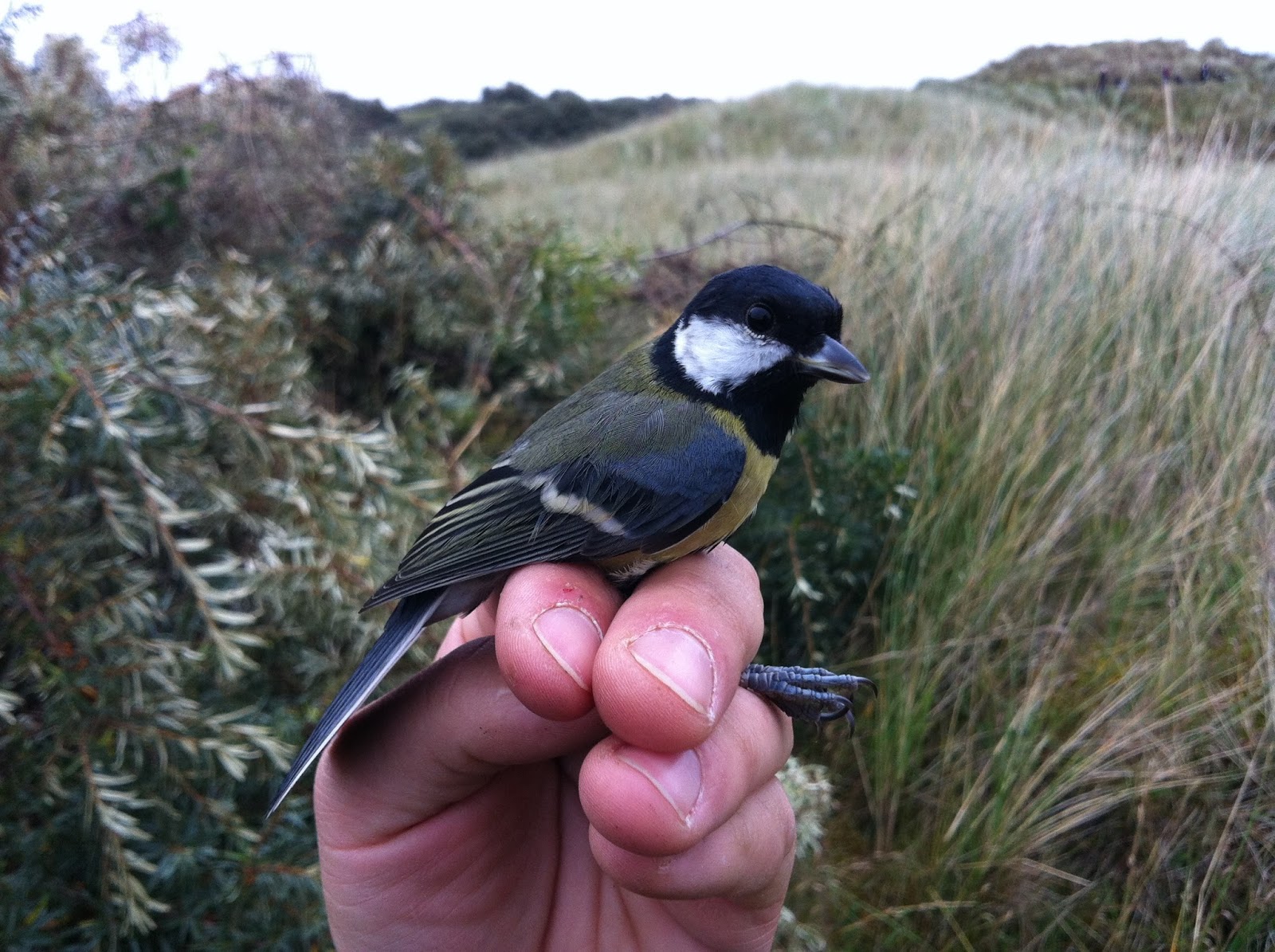
Another common breeding species across Ireland, generally in wooded areas.  The majority are caught at feeding stations, plus many pullus ringed in nest boxes. 
There appears to a general trend of increasing numbers of Great Tit being ringed since 1975.  The lowest total came in 1978 with 266 birds trapped, rising to the most productive year in 2014 with 1,441.  A total of 31,566 have been ringed in Ireland since 1975.


Blue Tit


A species similar to Great Tit in habits and trapped in a similar manner.  They are a delightful looking bird but are feisty little things and can be tricky to extract from mist nets.
Overall the trend seems relatively steady, although there are many more peaks and a few troughs.  1985 was the most productive year with 2,140 and 1978 the least with 690.  A total of 53,232 have been ringed in Ireland since 1975. 


Coal Tit


The majority of these records will refer to the Irish race of Coal Tit, Periparus ater hibernicus.  British and Continental Coal Tits do appear on the offshore islands and coastal watch points in autumn but no distinction has been made for birds ringed.
Generally the number of Coal Tits ringed seems steady with only one large dip (256 & 214) in 2006-2007 and a large spike (933) in 2012.  The majority of Coal Tits are ringed around feeding stations and the numbers really increase in prolonged bad weather in winter, when the birds descend from the coniferous plantations into Irish gardens. 
A total of 9,193 Coal Tits have been ringed in Northern Ireland since 1977, with 7,588 in the south.