Showing posts with label Song Thrush. Show all posts

Thursday, 5 December 2019

Shifting Shores

The time has come again when we shift shores from the east (north) shore of the Bann Estuary to the west shore at Castlerock Golf Club. As usual the focus here are the nets set amongst the millions of Sea Buckthorn berries which support a nice mix of finches and thrushes.
This year we have finally set up a feeding station with mixed seed and nyjer on offer.
The first two visits were only sample catches whilst we prepared the net rides and set up the feeding station, with the later two visits being more focused on ringing. We have still got two of the net rides to clear but the catches have been steady that we haven't found the time as yet.

Snow Bunting

The star bird so far was a Snow Bunting which was caught at first light not far from the feeders. This is the first to be ringed in Northern Ireland since 1998 with possibly as few as 13 ringed in all of Ireland since 1952. 

Snipe

There is a fantastic small marsh close by which I've recorded as holding up to 69 Common Snipe and 5 Jack Snipe. On one of the visits we set some nets along the edge of the pool in the dark hoping to catch some of the Snipe on return to the pool after feeding in the nearby fields at night. We only caught a single Snipe and flushed another 7/8. There were at least 3 Jack Snipe present also and with a little net rejig, we have more luck next time. 

Fieldfare

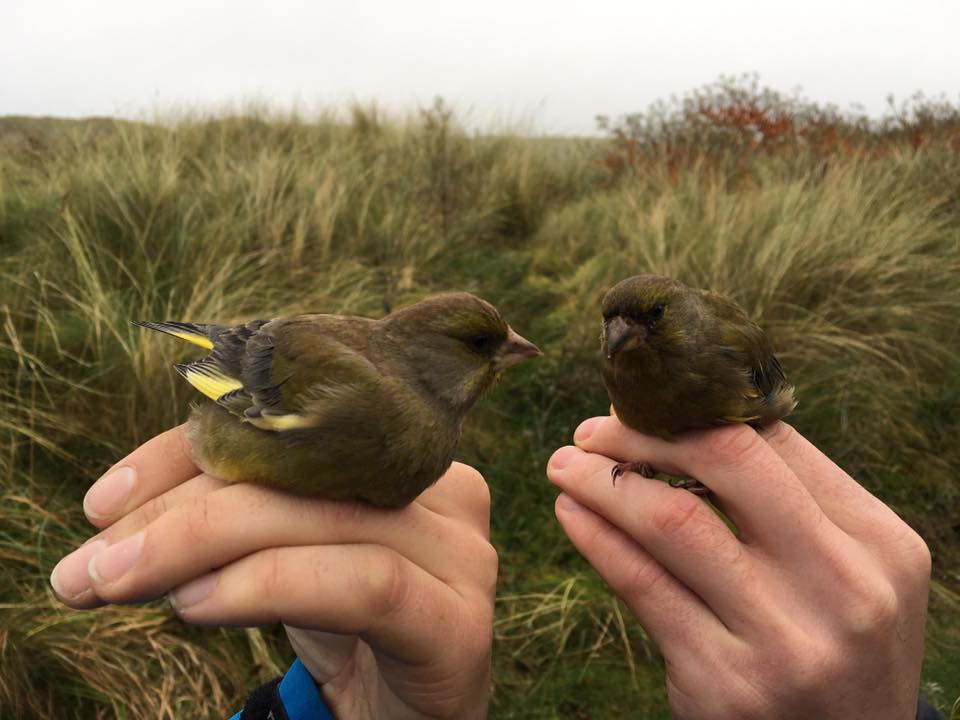
The other catches have been healthy with lots of Bullfinches and good numbers of Song Thrushes present. What has been noticeable in their absence are the Fieldfares with just one seen and caught when the wintering population can number up to 600 and is normally around 100 birds daily. Chaffinches too are absent with one caught and not many more present, usually there are 30-40 and regularly caught.
The feeders have attracted in some Goldfinches and Linnets with a few caught and they will hopefully continue to attract more birds into the spring - perhaps not too many tit species! 


Castlerock Golf Club - November - 1st December 2019

                      New      Retrap
Blackbird          6           2
Blue Tit             3           1
Bullfinch          15          6              
Chaffinch          1
Dunnock           4           1
Fieldfare            1
Goldcrest           2
Goldfinch         12          1
Greenfinch        6
Linnet               10
Robin                 4           1
Snipe                  1
Snow Bunting    1
Song Thrush      9
Wren                   3

Total                  78        12                


Wednesday, 28 November 2018

Castlerock Golf Club 24/11/2018 & Scottish Chaffinch

On Saturday morning John and I shifted out attentions to the west shore of the Bann Estuary and made our first visit to Castlerock Golf Club of the winter. As you regular readers will know, this is somewhat similar habitat to that of Portstewart Strand but much smaller in area and all the Sea Buckthorn plants are female meaning they produce millions of berries and attract some large numbers of thrushes and finches, but generally in late winter.


As we hadn't been to the site since the 7th of January at the start of the year the net rides needed to be cleared of the brambles, nettles and quite a bit of cutting back of fallen bushes and branches. We tackled the easy ride first and had the first 18 metres net up and catching within 20 minutes and had the second 12m ride up and running in another 20 minutes. The nets started to catch a few birds so our progress in the other rides was slowed and we didn't quite get finished but did get another 24m cleared with another 18m to go. The session was cut short because of a very unfortunate discovery  on the receding tide.

The location of our nets generally follow the bottom of the hollow of the main stand of Sea Buckthorn but this tends not to be the best place to intercept the thrushes which stick to the higher bushes on the slopes - we had up to 600 Fieldfare feeding amongst the scrub last winter and we only caught one! At the same time we probably had a mixed flock of up to 175 Redwing, Blackbirds & Song Thrush and again only caught three, six and seven respectively. We are eyeing up new potential net rides which might rectify this a bit but working with the steep slopes and avoiding flying golf balls isn't easy!

A net full of Chaffinches & a couple of Blue Tits


From the two nets in a couple of hours we caught 18 new birds and controlled a female Chaffinch with a BTO ring. There were only 6 Fieldfare present and again they avoided the nets.

Castlerock Golf Club 24th November 2018

                          New          Control
Blue Tit               2
Bullfinch             4
Chaffinch            8                   1
Dunnock             1
Robin                  1
Song Thrush       2

Total                 18                   1         


The new BTO system means that you receive details of controls within a few days, subject to them being uploaded by the other ringer.
This controlled Chaffinch was ringed at Drummond, Inverness on the 17th of September 2018 and controlled by us 68 days later at a minimum distance of 298km. This is our second control Chaffinch for the Bann Estuary with the last bird also coming from the Highlands of Scotland near Shielfoot (marked below) in a very similar movement. She was quite a large winged lady so possibly a Scandinavian moving through Scotland.

Chaffinch from Inverness to Castlerock


Tuesday, 10 October 2017

Portstewart Strand 30/09/2017

Well after all the debate over the weather and getting the greenlight I arrived at Donaghadee Harbour on Friday evening only to find out the boat to Copeland Bird Observatory was out of action and it would be at least Saturday morning before it would be fixed. It was a little too far for me to travel back to the north coast and return again the next morning so I gave it a miss but five of the group of eight did make it out. It is a real shame as the conditions would have been great on Saturday morning for ringing, with Sunday much windier and wet. We have had great problems this September getting to the Observatory with the preceding two weekends also not possible and this is peak time for many of our common migrants and also our peak time for rarities.

Stonechat

Saturday (30th) morning wasn't completely lost to me as I headed down to Portstewart Strand with John in what felt like a proper autumnal day and the first day where the mist net poles get too cold to touch! There was a little breeze first thing but this was to ease gradually. It did ease at times and completely disappeared only to return stronger within 10 minutes - strange!


The Long-eared Owls are still hanging about amongst the scrub and we are now up to three birds. One narrowly missed the 6m net at west ride as it was coming in to roost.
The number of new birds trapped was down on recent visits but we are retrapping more of the birds ringed in the past few weeks.


Portstewart Strand 30/09/2017                            
                              New         Retrap
Blackbird               2
Blackcap                5                  1
Bullfinch                2                  2
Chaffinch               1          
Dunnock                2                  3
Goldcrest               1                  1

Goldfinch               1
Great Tit                 1                 1            
Meadow Pipit         2
Robin                      1                 2
Song Thrush          5 

Stonechat                                   1
Wren                      1  


Totals                    24                 11    


I've had a sit down this week and updated all the ringing data and bird logs and had a look at our return so far. We were really slacking early season with only 92 new birds ringed between April and the 12th of July but this was generally down to effort. We are roughly 180 new birds short on our total for the site in 2016 and around 320 short on 2015. We have also handled seven less species this year but we still have around two months to improve the situation.
On the positive side, it is already our best year ever for Blackcap and Goldcrest and I would imagine we will catch a few more before the season is out.


We are planning a visit on Friday and possibly Sunday morning, and after a few days of strong westerlies we don't really know what to expect. We are shielded by Donegal so it is unlikely that any American passerines will make it our way but at least one has before! 

Great Crested Grebe

The PatchWork Challenge total is now up to 118 species with the addition of a Great Northern Diver. The first Whooper Swans, Greylag Geese and Great Crested Grebe of autumn have been sighted in the past week with the Brent Geese arriving the week before.   

Saturday, 3 December 2016

Quick Start to Winter

The Sea Buckthorn bushes at Castlerock Golf Course are still drooping from the weight of the millions of bright orange berries and attracting good numbers of birds.  The first frosts seem to have trigged the fermentation of the berries and they are beginning to ooze with an aroma of what I'd imagine an alcoholic Balsamic Vinegar would smell like. 
There are good numbers of Blackbird, Song Thrush, Chaffinch, Greenfinch and Bullfinch gorging on the berries but the hoped for winter thrushes are lacking with only a couple of Fieldfare floating by and a single Redwing overhead.
On the first visit last Saturday David, Dean and I spent half an hour clearing the brambles etc. from the net rides but we were up and running fairly quickly.  We trapped a total of 35 new birds including the first Greenfinches I've caught this year (hard to come by these days) plus our first fledged House Sparrow for the year and the first for the estuary.

Greenfinches

Dean and I were down again this morning with another decent catch of 27 new birds and 6 retraps from the previous week.  The best of the birds was a female Blackcap which are always special birds in winter.  The nice morning was boosted with the sightings of Harbour Porpoises, Grey Seal and 54 species of birds including 1500+ LapwingPeregrineRed-throated Diver, GannetGoldeneye and a patch tick in the form of a female Pheasant - species 122 for the patch this year!           

Blackcap

PSS Ringing Totals 26/11/2016 + 03/12/2016
                                New      Retrap
Blackbird                   4                          
Blackcap                   1
Blue Tit                    13              3
Bullfinch                    4
Chaffinch                 15             
Dunnock                   1            
Goldcrest                  1
Goldfinch                  1
Greenfinch                8
House Sparrow         1
Reed Bunting            1  
Robin                        7              3
Song Thrush             5          

Total                        62             6            


Sea Buckthorn

We didn't visit the site until the end of December last year (when we also set it up) and we anticipate the berries to last at least March, so that should keep is busy until the return of spring.

Dean and David with the ringing buggy (handy for the walk to get to the site)

In my traipsing's across the Bann Estuary I have found a few great pools which hold good numbers of Snipe and the odd Jack Snipe.  I visited one of these pools 3/4 weeks and flushed 69 Snipe in a relatively small area.  Before the first visit to Castlerock we thought we would put up a couple of nets and see if we could catch any before dawn. It didn't go quite as planned and the c20 Snipe we flushed all swung left and flushed out over the estuary rather than going straight towards the nets.  We devised a new plan and gave it a quick attempt a few evenings later, this time with a line of 58 metres of net parallel with the shore and 18m at 90 degrees on the end.  Unfortunately while setting the nets before darkness we managed to flush 16 Snipe even though we were trying to be as quiet as possible.  There were only 2 birds left in the pool as we splashed through and again they missed.
We will probably give it one last attempt but set the nets in complete darkness early morning to see if that does the trick! 


You may remember that we had sighted a couple of Long-eared Owls roosting in the scrub at Portstewart Strand during the ringing attempts in October so we thought it would be worth a go at catching them.  We have had a bit of luck in the past at mist netting the birds in darkness at the University but the success rate, is of course, very low.
John and Dean gave it a first attempt at PSS last week and managed to attract three LEO's in the vicinity of the nets and one bird was very close to being trapped but unfortunately it veered to the side of the net.
We gave it another attempt last night with the net placement tweaked a little but to no avail.  We may have glimpsed a bird ghost behind us but that was about the height of it.
We did strike with two Redshanks, caught in a net placed along the mudflats in the low tide. 

A few weeks back I joined David and Phil from Copeland Bird Observatory to help run the first of this winters ringing training programme in Antrim.  We had a full quota of 5 trainees and had a pretty good morning, although we were restricted to around 3 hours.  The site has a fantastic supply of berries, a small orchard, a wild bird seed cover field and a couple of feeders, so plenty to work with.  There were a large number of Linnets, House Sparrow and Chaffinch feeding in the 'wild bird table' and we managed to catch a small fraction, including 20 Linnet and 2 House Sparrow.  The small orchard was rammed with Blackbirds on arrival but only 6 were caught.  We can only access the site after 08.30, so we miss the opportunity to get the nets up before first light but a catch of 72 new birds was still great!


CBO Winter Training - Antrim 19/11/2016
                                New      Retrap
Blackbird                   6              1            
Blue Tit                      5              1
Bullfinch                    1   
Chaffinch                  11             2
Coal Tit                      2
Dunnock                     1          
Goldcrest                    2
Great Tit                    13            1           
House Sparrow           2
Lesser Redpoll           1
Linnet                        20
Long-tailed Tit            5
Robin                         2              1
Song Thrush              1           

Total                          72             6            

House Sparrow

There will be a further 4 training events from now to March, with one a month, then it's back to the Observatory for the 2017 season. 


Our ringing attempts for the rest of the year will probably be more of the same, although we may return to the university to try and catch some LEO at the traditional site.  When down and around Portstewart Strand in the dark we heard pretty big numbers of waders roosting on the far side so we may return to Grangemore for another attempt or two. 

The Blog has hit a new milestone in the last few days topping the 25k mark, sitting on over 25700 this evening.  The reading rate has certainly increased as time has gone on and the next 25k should hopefully come much faster!


Thursday, 3 November 2016

Copeland Bird Observatory 28-30th October

On Friday evening Richard, David, James, Laurence and I (Steve) were joined by 2 non-ringers Andy and Pat to begin our journey to Copeland Bird Observatory from Donaghadee Harbour. Of course we could not begin our trip without grabbing our usual pre-CBO feed from the local chippy – delicious!  The journey across on The Mermaid is much slower than on the Observatories RHIB but it did give us a chance to observe Turnstones, Cormorants/Shags, Red-breasted Merganser and many gulls off Big Copeland.  The weather was good, with a slight South Westerly breeze, we were fairly optimistic that the weather would remain calm and fine for the weekend ahead.
Yellow-browed Warbler   (DS)

On reaching the island at dusk, we set about getting the mist nets up in the usual net rides at mid garden, NW Garden, Heli 60’, Heli Extension, Thicket, Pond 60', Withy, Millennium Wood, the Ditch and a new net ride at Bluebell.  We also set the four Heligoland traps, the Crow trap and a few Potter and Spring traps.  The Potters were baited with sardines as they have been producing the goods with Water Rail recently.  It was well into darkness by the time we got finished so all nets were furled as we went, ready for a busy day on Saturday.  While erecting the last net c30 Greylag Geese came in to roost on Mew Island – and what a racket they made!
Fieldfare

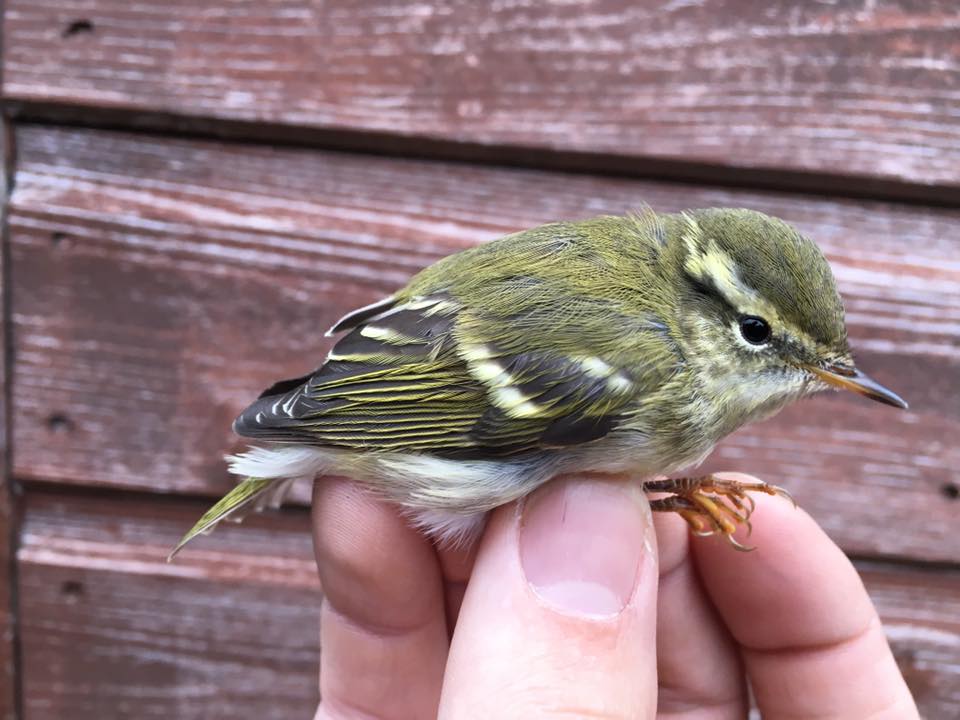
The next day Richard and I got up earlier than the others to prepare the nets and tape lures before dawn.  Being so late in the autumn, the main migrants passing through were thrushes with Blackbird, Song Thrush and Redwing.  The species that really caught our attention though were the Fieldfare.  Two of the Fieldfares wound up in mist nets and both, with beautiful speckled markings on their orangey throats.  This set the mood for the rest of the day. The first weekend of October 2015 saw us with high hopes of catching a Yellow-browed Warbler; a bird ringed less than 10 times before in Northern Ireland.  Being so late, the chances of getting one were slim but by 10am, I had a Yellow-browed Warbler in my hand and it was beautiful.  Lesser Redpoll numbers tend to dwindle around late October but we still had a few passing through, including a Goldpoll (a Redpoll with a golden crown in place of red) and a BTO Control (ringed somewhere else in the UK or Ireland).
Lesser Redpoll   (DS)
Song Thrush (top) and Redwing (bottom)   (DS)
Later that morning a flock of c120 Starling and a mixed flock of c150 Redwing, Fieldfare and Song Thrush passed over the island.  As well as the Yellow-browed Warbler we added another new species for the year in the form of two Wigeon amongst a flock of over 90 Teal off Mew Island. In the evening we caught a glimpse of a female Sparrowhawk but it made its way back towards big Copeland and a Buzzard was perched on the Mew Lighthouse.  A Short-eared Owl was spotted on Big Copeland although not by us unfortunately, as this would have been a nice addition to the CBO year list.
Redwing
The next day the Yellow-browed Warbler was relocated in Bluebell Gully where it had been last heard on Saturday afternoon.  There were a few more Lesser Redpoll, Redwing, Song Thrush, Goldfinch, Linnet and Blackbird on the move.  The Gully heligoland trap performed well producing a six Meadow Pipit but with the trap being unfinished it could have possibly caught more.  There were a good number of Grey Seal pups scattered around the island, snuggled in amongst the rocks with their mothers close by.  The glorious weather on Sunday, which felt like earlier September, produced a late migrant butterfly - a Red Admiral
Grey Seal Pup   (SF)

Ringing Totals for Copeland Bird Observatory 29-30th October
                                             New    Retraps  Controls
Blackbird                               3           5
Blackcap                               2
Chaffinch                              4
Dunnock                                         4
Fieldfare                               2
Goldcrest                             1            2
Goldfinch                              2
Linnet                                    1
Lesser Redpoll                    24                          1
Meadow Pipit                      6
Redwing                               14         1
Robin                                     1          8
Song Thrush                         5           1
Wren                                      3          4
Yellow-browed Warbler    1

Total                                     74        25             1 __      

As this was the last visit of the season we were set with a list of end of season chores.  After these were completed we were able to relax and wait for the boat to arrive.  We brought five lawnmowers ashore for servicing and it must have been quite a sight watching us lift the heavy machines off the boat and carrying them up on the steps of the harbour walls on our return to Donaghadee.
 The team ready for home
Fully packed boat home
As we left Copeland Bird Observatory behind us, the sun was dropping behind the mainland and brought a close on a very successful weekend and yet another brilliant season at Northern Ireland's only bird observatory.  Bring on next year as I'm sure everyone who has been to the island is desperately longing to return.
The Observatory building locked up and ready for winter
 Sunset over Donaghadee
Myself (Steve), Richard and David

Richard will be back at the weekend with an update about the goings on back at home over the last week. 

Steve Fyffe

Tuesday, 25 October 2016

Portstewart Strand 22+25th October 2016

Well after complaining about the lack of warblers of late we were finally delivered a Chiffchaff, which are scarce enough around the ringing site and it is only the third ringed this year (also 3 ringed in 2015).  The migrating birds have continued in a similar theme over the last couple of visits on the 22nd and 25th with plenty of Blackbirds, Chaffinch, Skylarks, Song Thrushes, Teal, Whooper Swans etc.   The conditions were ideal for the ringing visits of Dean & I on Saturday and John & Dean this morning (Tuesday) although temperatures have dropped down close to freezing but still no frost! 


Chiffchaff


The catches are still slightly lower than usual with the finches still missing but decent numbers of Blackbird and Song Thrush did make up for that.  We also caught yet another Stonechat making it the twelve for the year and the Chiffchaff the third as mentioned above.  It looks like we have had another small arrival of Goldcrests and 5 more new birds were caught.  Redwings continue to pass through in small numbers and we had attracted c10 birds around the nets on Saturday morning but all managed to remain unringed. 


Blackbird


PSS Ringing Totals 22 + 25/10/2016
                                New      Retrap
Blackbird                   7              2              
Blue Tit                     4              1
Chaffinch                  5              1 
Chiffchaff                  1
 Dunnock                   2             2
Goldcrest                   5
Goldfinch                  1
Great Tit                    1              5
Linnet                        2
Meadow Pipit            10
Robin                         4              2  
Song Thrush              7
Stonechat                   1
Wren                          2              5           

Total                        52             18            

On the very windy Sunday morning I was on site again around first light to do a little work to some of the net rides.  I was about for around 4 hours but noticed few birds other than some Blackbirds, Song Thrushes and a Sparrowhawk.  I did get quite a bit done with the chainsaw despite the chain coming off twice (real pain if it jams) but I'll need another morning or two to finish off everything we've planned - more net rides that are protected from the wind in various directions plus lowering a few trees at the side of East Ride.


Steve was down home in Gortin, County Tyrone at the weekend and headed out to one of his woodland ringing sites.  The catch was pretty decent considering the site has no feeders to focus the birds into one area.  He did have a flock of c40 Redwing pass over mid-morning and they showed a bit of interest in the Latvian Redwing tape but only one bird hit the nets.

Treecreeper (SF)

Gortin Ringing Totals
                           New        Retrap
Blue Tit                 7
Coal Tit                 1
Goldcrest               2
Great Tit                                1
Long-tailed Tit       5
Redwing                1
Song Thrush          2
Treecreeper           1
Wren                      2

Total                    21              1            


Redwing (SF)


Friday, 14 October 2016

Early October

The spell of easterlies has continued into a second week and they've gradually got stronger and brought some wetter weather in the later half of this week.  In the quieter spells we managed another couple of visits to Portstewart Strand in what you would call 'ideal conditions'.
The hoped for rarities from the east didn't materialise and Northern Ireland managed just two Yellow-browned Warblers when there have probably been 1000+ across the UK and Ireland including 50 ringed at Cape Clear Bird Observatory at the far end of Ireland.  NI didn't miss out totally and notched up its first Red-flanked Bluetail and a nice Red-breasted Flycatcher - all four birds in County Down.
We on the other hand couldn't even muster a Blackcap or Chiffchaff but we have seen a continued run of thrushes.  The first few Redwings started passing through last Friday with further Blackbirds, Song Thrushes and the first Mistle Thrush I've seen at Portstewart Strand itself. Goldcrests continue to flit through with birds scattered everywhere through the scrub.  Other notable arrivals include more new Stonechats, another wave of Blue Tits (no doubt local), 3+ Great Creasted Grebes, flocks of Skylarks, the first Jack Snipe of the year and a Long-tailed Duck which I missed.

Skylark

Ringing was by no means prolific but another 3 new Stonechats and a Skylark were nice catches. October was the best month for numbers last year so hopefully things will pick up with a return of some northerlies.

Stonechat

PSS Ringing Totals 07 - 11/10/2016
                                New      Retrap
Blackbird                    6             2
Blue Tit                      7    
Bullfinch                    1
Chaffinch                   3                  
Dunnock                                    2
Goldcrest                   4    
Goldfinch                   5              3
Great Tit                    4               3
Meadow Pipit            3
Reed Bunting            1
Robin                         1               2
Skylark                      1       
Song Thrush             4
Stonechat                  3               1
Wren                         2               1              

Total                       45               14             

Song Thrush

Last week Ken hosted Siobhan in his garden for another training session.  Conditions were good and the number of birds visiting the feeders continue to build.  Chaffinch, as usual, were top of the bill with 13 new birds while Coals Tits were the most numerous species processed with 18.


Kens Garden 06/10/2016
                                New      Retrap
Blue Tit                       7            4    
Chaffinch                   13           3        
Coal Tit                      9             9
Dunnock                    1              1
Goldcrest                   2    
Goldfinch                   8
Great Tit                    8              6
Robin                         4              2
Wren                         4                          

Total                       56              25             


Unfortunately our weekend trip to Copeland Bird Observatory has been canceled due to the weather but we will hopefully get rescheduled for a couple of weeks time.  As such, the prospects for weekend ringing look limited to a wind restricted short window on Saturday morning but we may give it a go.

We've had word of another Storm Petrel recovery but I'll update on that next time.


Tuesday, 22 December 2015

Irish Bird Ringing Data - Thrushes


Since 1975, a total of eight species of Thrush have been ringed in Ireland.  Those include the resident breeders of Blackbird, Song Thrush & Mistle Thrush, the rare breeder, Ring Ouzel and the wintering thrushes of Fieldfare and Redwing.  There are also a couple of very rare species to have been ringed -  White's Thrush and  Grey-cheeked Thrush.  There are a further three species of Thrush that have been recorded in Ireland which include - Hermit Thrush, Siberian Thrush and Swainson's Thrush. 
Three (4) White's Thrush have been trapped in Ireland, with the first at Copeland Bird Observatory (CBO) back in 1993.  The only other ringing records came in 2009 but the data doesn't quite match - certainly two but potentially three were ringed in Ireland in this year.  This is very impressive for an eastern Thrush, with only 12 ringed in the UK and Ireland since 1909. 
Four Grey-cheeked Thrush have been ringed in Ireland, coming in a 10 year period between 1982-91.  The bird caught at Cape Clear in October 1982 was a first for Ireland.  A total of 16 have been caught in the UK and Ireland since 1909. 


Blackbird

The Blackbird is one of the most recognisable species in Ireland, which frequent gardens up and down the island.  Come winter we receive a large influx of birds from northern Europe, which join our resident birds - a few of which will move south for winter.
The Scandinavian birds tend to differ from our resident Blackbirds, often larger, heavier and can have slight differences in appearance i.e. the bill colouration.
  
The graph below shows a decline in the numbers being trapped before it levels off over the last 20 years.  Copeland BO shows a steady decline in the totals trapped at the Observatory below. 

  1956-65          1966-75          1976-85          1986-95          1996-05
1,235                996                  499                  343                220

The suggested explanation for the decline in numbers caught at the Observatory over the years is the ever increasing bright lights of Belfast and the mainland.  With this, this lighthouse no longer attracts the birds that it used to.  This may account for some of downward trend across the board but probably limited to only a couple of the coastal ringing sites. 
Since 1977 there have been 12,013 trapped in the north and 13,366 in the south.  The most productive year in Ireland was 1985 with 1,429 and the least 2008, with 394. 


 Given the number of Blackbird recoveries, I have separated them into three maps.  The first shows the birds coming in from Britain, the second from Europe and the third, birds leaving Ireland.  The data presented includes only a selection of the recoveries, with many more not available to me.  Between 1983-86 for example there were further recoveries not included - 13 Norway, 2 Netherlands, 3 Denmark, 3 Sweden and 1 Germany. 
A few of the most distant movements include birds to Latvia, Finland and northern Norway, some moving over 2,000km.  Some of the key sites during migration include Helgoland, off the Germany Coast and the Lincolnshire/Yorkshire coast, particularly Spurn Point.   
For both the birds coming in and going out, the majority fit well within the general south west/north east movements, with only a few birds moving in different directions. 
Unfortunately for the Blackbirds, most of the recoveries come from dead birds - cats and cars are the big killers. 

 Blackbirds coming into Ireland from Britain
Blackbirds coming into Ireland from Europe
Blackbirds leaving Ireland

Ring Ouzel


The Ring Ouzel is a rare breeder in Ireland with only a handful of pairs each year in the mountains of the north and west.  It is more commonly seen on passage during the spring and autumn with c25-50 birds a year.  The majority of these records come from the south coast around Cork and Wexford, with a few records every other year in Northern Ireland.
I was fortunate to get my hands on the bird pictured above last year - the first trapped in the north since 2000. 
The graph doesn't present much in the way of trends but the birds were certainly caught on a regular basis in the late seventies to eighties.  At Copeland BO they trapped 21 Ring Ouzel from 1954-1984 and only two in the thirty years since - including the bird above.  Only 17 have been caught across Ireland since 1977 and apparently no recoveries. 


Fieldfare
 

These Nordic beauties spend the winter in Ireland roving around in mixed flocks with Redwings.  The species was traditionally targeted at roost sites and orchards but there has been little focus on the species in recent years. 
A total of 2,432 Fieldfare have been ringed in Ireland since 1975 - the most productive year was in 1985 with 495 birds, 399 of those in the south.  I can't comment on the weather conditions in Scandinavia in 1985 or ringing effort in Ireland but it was also the most productive year for Blackbird, Redwings and Song Thrush.  There were no birds caught in 1994 and 1998. 


The recovery map below is quite misleading in that it would have you believe that these birds are passing through Ireland and wintering in southern Europe.  None of the movements into southern Europe go directly from Ireland but are during subsequent winters, having returned to Scandinavia to breed at least once.  These birds have, for some reason, chosen pastures new to spend the winter months, perhaps simply wind direction at the start of migration. 
A ringing site in Lucan, Dublin during the 1980's was very productive and accounts for 9 of the 17 birds ringed in Ireland that were recovered elsewhere.  These include - 3 to Finland, 2 to Italy, 3 Norway and 1 to France.   This site has managed a number of recaptures of birds over many years, proving some birds are site faithful. 
The species is quite different from Blackbird for example, because few of these birds are caught at coastal bird observatories, but rather, further inland in breeding/wintering locations.  This, may be in part, due to the fact the birds migrate in late autumn when many of the observatories have closed, particularly in Scandinavia. 

Fieldfare recoveries into (green) and out (red) of Ireland 


Redwing


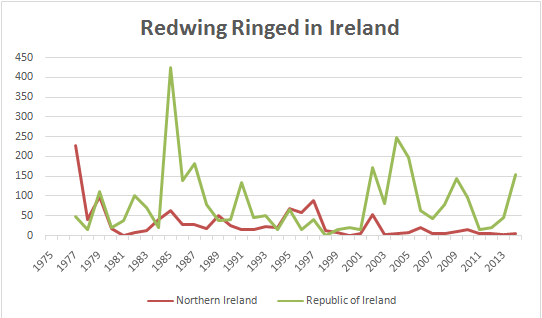
In Ireland, the majority of the Redwings that hit our shores in winter are supposedly of the Icelandic race 'Turdus iliacus coburni' with a few of the nominate Northern European race ' Turdus iliacus iliacus'
Despite being similar in nature and the obvious spike that correlates with Fieldfare, the two graphs differ, with Redwing fluctuating much more. 
A total of 4,519 have been ringed in Ireland since 1975.  As mentioned above, 1985 seen the most trapped, with 488 and the lowest was only 20 caught in both 2000 & 2001.  I probably would have expected the capture rate between Redwing/Fieldfare to have been greater than roughly 2/1. 


The ringing recoveries show a greater number of the nominate race coming into Ireland but this is probably down to the limited number of ringers in Iceland.  A couple of the Icelandic recoveries are very nice as they refer to birds ringed in the nest, so their birth location is known.  Some of the recoveries out of Ireland are far flung with Finland, Portugal, Poland and Cyprus.  The Portuguese and Cypriot recoveries come in subsequent winters and not directly from Ireland.  It might be possible to presume that the two birds wintering in Portugal are of the Icelandic race and step stone through Ireland - particularly the bird ringed at the Bridges of Ross, Clare.  The bird in Cyprus being so far east, is more likely from the nominate race.  The greatest distance travelled is a minimum of 2,943km from Russia. 
Redwings tend to frequent bird observatories more so than Fieldfare but there are many more of them and they are easily attracted to tape lures. 
Again, not all the recoveries are available and there are at least another 8 from Iceland, 2 Norway, 1 Finland, 1 Netherlands and 1 Fair Isle, Shetland.


Redwing recoveries coming into (green) and out (red) of Ireland


Check out Peter Alkers blog -'Two in a Bush' for nice comparisons of the two races
http://two-in-a-bush.blogspot.co.uk/2014/11/redwings-coburni-v-iliacus.html


Song Thrush


A resident breeder with an influx of birds from the continent for the winter.  Similar to the Blackbird, the continental birds can appear different from our resident birds, again often larger & heavier, with more greyish feathering above and whiter below.  Unfortunately this is yet another species that is declining greatly and this is reciprocated in the ringing totals.  It will be interesting to see the ringing results for 2015, as it looks to have been a better breeding season going by the number of juveniles we caught personally. 
A total of 8,401 Song Thrush have been ringed in Ireland since 1975, again 1985 was the best year with 420 and the worst was 2002 with 37. 


The birds coming into Ireland seem to come in two main directions - a westerly passage through east England via Germany and Denmark and then a south west movement pouring in via the Northern Isles of Scotland, possibly from Scandinavia.  There are also then some probable Scottish breeding birds than winter in Ireland.  There is at least one Norwegian recovery but I do not have the precise details of this one.  The bird recovered in Ponferrada, Spain is interesting and is presumably a bird that passed through Ireland (Great Saltee) in late autumn to winter in Iberia. 

Song Thrush recoveries coming into (green) and out (red) of Ireland


Check out Peter Alkers blog -Two in a Bush for nice comparisons of the two races
http://two-in-a-bush.blogspot.co.uk/2015/10/thrush-fest.html


Mistle Thrush


A large resident Thrush with a handful of immigrants during the winter.  There is a steady decline in the numbers being caught, which correlates with the decreasing populations nationwide.  The species is not easily caught, as they tend to stick to the high trees and open ground.  The best opportunities are around fruiting trees/bushes in winter or chicks in the nest. 
This is one of the few species where there have been many more ringed in the north - 770 than south - 338 since 1977.  In 1987, 92 birds were trapped in Ireland, falling to the lowest catches of 3 in 2012 and 2014. 
There are apparently no recoveries of this species coming into or leaving Ireland.