Showing posts with label Bann Estuary. Show all posts

Thursday, 24 October 2019

Portstewart Strand Dunes Autumn 2019

Autumn at Portstewart has been ticking a long with reasonable catches but no stand out birds or large catches as yet. Effort has been down quite a bit as I've been running solo at the dunes up until the middle of October and I have otherwise been distracted getting married in mid-September then heading off for a few weeks to South Africa & Dubai.

Fieldfare


In total since August there have been 11 visits, 3 in August, 5 in September and 3 in October with 254 new birds caught. The most productive visit was on the 18th of September with 68 birds trapped, made up of a big catch of Linnets. I've been making more of an effort to catch Linnets this autumn in the hopes of getting some retraps and build a better of picture of where the birds come from. At the moment, the only retraps I generally get are during the breeding season when a couple of pairs seem to nest very close to a couple of the gorse nets. Otherwise, the flocks of birds passing through seem to be new.

Linnet

We added another new species for the Bann Estuary with the capture of a Grey Wagtail using a tape lure early morning, a further two were attracted in on the same morning but not caught. The Fieldfare caught on the last visit on the 21st of October was a first for the dunes at Portstewart Strand. That makes it 59 different species trapped in the estuary since autumn 2014, with 43 species trapped at Portstewart Strand.
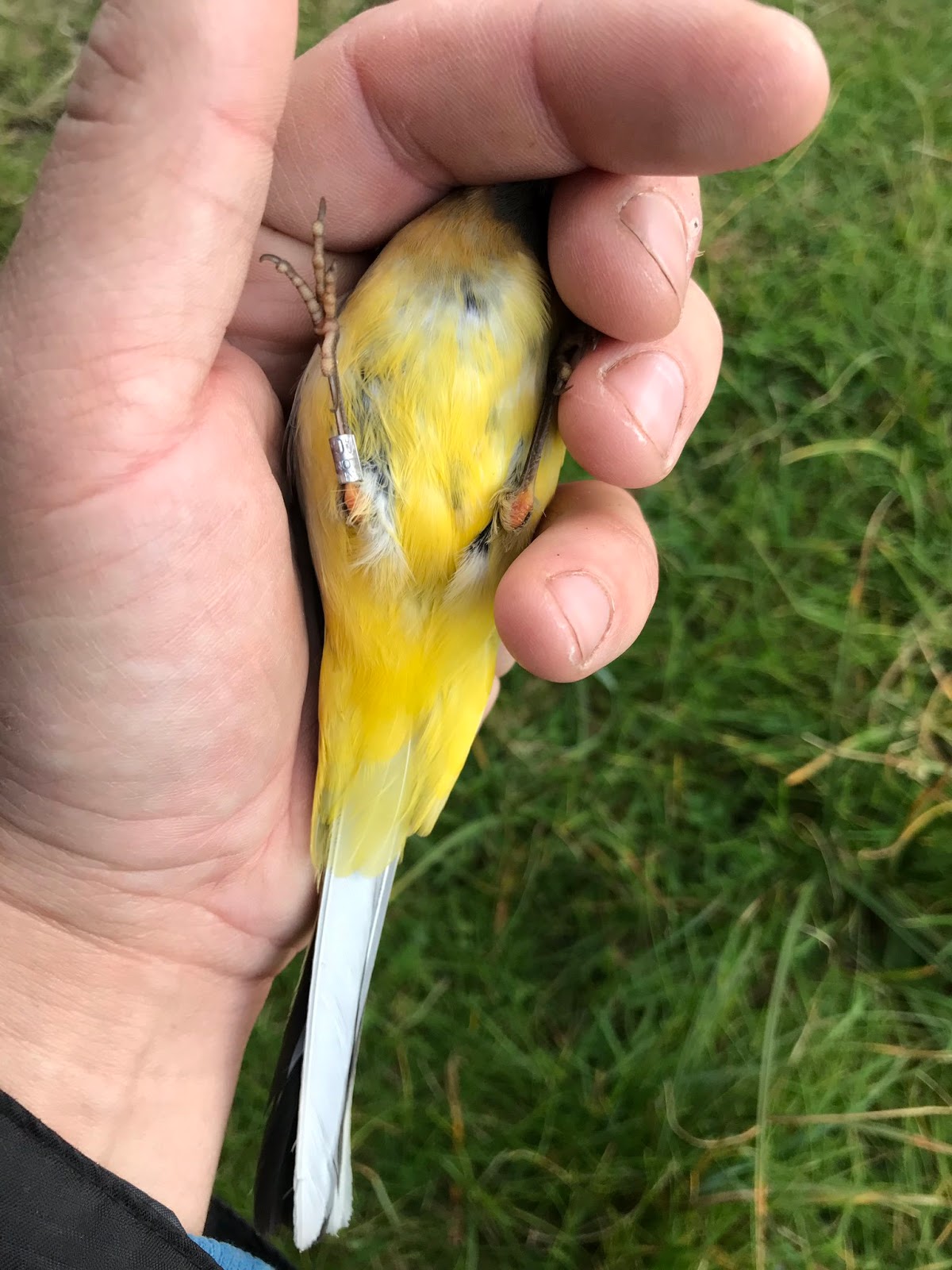
Underside of a Grey Wagtail

                                         New     Retrap

Blackbird                            4            3
Blackcap                            4            

Blue Tit                               1            1                

Bullfinch                             8            2
Chaffinch                            4            2    
Dunnock                            16           8
Fieldfare                              1
Goldcrest                           11          3              
Goldfinch                           31
Great Tit                              2           4
Grey Wagtail                       1
Linnet                                 85
Meadow Pipit                     30
Redwing                              2
Reed Bunting                     1
Robin                                  11          6
Song Thrush                       5

Stonechat                          11          
Swallow                              1  
Whitethroat                         1      
Willow Warbler                   5                 

Wren                                   19        10
              

Total                                  254       40          


Willow Warbler

At the moment it's looking to be a very poor year for Blackcaps and Reed Buntings, effort on catching Meadow Pipits has been down and Blackbird, Song Thrush and Chaffinch numbers are lower but generally October and early November are the best period for those. Willow Warbler has done quite well since the drastic habitat loss but still less than half the number caught in 2015.


The remnant scrub is very patchy and undoubtedly we have lost a large population of breeding birds. My hope is that the migrants passing through will still remain consistent but with much fewer ideal net rides and with those remaining more susceptible to the wind, it makes it more challenging.


What remains of my favourite former net ride, which used to measure 90 metres, now only fits a 9 metre net - it was great for Blackcaps and chipped in with Garden Warbler & Lesser Whitethroat.

One thing that has remained consistent is the continual flow of litter down the river. My new pet hate are shotgun cartridges and wads which are never ending both here and at Lough Foyle and I've gathered 200+ this year. Every little bit I can do as I walk between nets does build up to be quite substantial.


Thursday, 28 March 2019

Bann Estuary 2018 Bird and Ringing Report

The Bird and Ringing Report for 2019 in the Bann Estuary is now available - if you'd rather view it as a PDF, click the link below - probably easier to read as a PDF with more clarity.

https://onedrive.live.com/?cid=EB63FB02E67B6B92&id=EB63FB02E67B6B92%218970&parId=EB63FB02E67B6B92%218953&o=OneUp

Friday, 9 September 2016

Waders and Swallows - Take 2

After the success of last Wednesdays wader and Swallow roost catches we went for a repeat performance on Monday evening (http://causewaycoastrg.blogspot.co.uk/2016/09/wader-bonaza-and-roosting-hirundines.html).  The prospects were a little better with high tide peaking roughly an hour after full darkness and we were a little closer to peak Swallow time in the estuary.  We had a team of five this time around with John, Ken, Siobhan, Steve and myself and the nets opened for around 7.30pm.  The evening was a scorcher with full sunshine and temperatures hitting 25°C at 7pm and although it clouded over a little, it was still a muggy 20°C on departure after 11pm.   

Snipe


The Swallow tapes worked immediately and attracted in c25 birds within a few minutes and over the next half an hour birds continued to trickle in and swarm overhead totalling around 1000 birds.  The commotion stirred up the resident Water Rails with 4/5 calling all around the reedbeds.  With the lower tide we were able to set two separate 18m nets slightly further in amongst the reeds. 
As with the last attempt, a number of waders and Teal etc. were flushed out of the pools when setting up the nets with the majority not returning.  We opted for the same set up but with an extra 18m three shelf net in the other pool without a tape.  The drier weather of late had dried out the pools a little, but as I write, it is raining cats and dogs, so I don't think it will be an issue on our next visit. 
There were a few other bits and pieces around the estuary with a Grey Seal, Otter and a couple of pipistrelle bats.

Sunset over the estuary

Given the number of Swallows that we had attracted in and the number that had dropped into the nets early we had to switch off the tapes.  The big flock circled overhead while we processed the other birds and eventually settled into the reebed just before dark.  Half had dropped in a bit earlier but a bird of prey (which we didn't get a proper look at) had flushed them back up. 
We caught a total of 73 Swallows, 4 Sand Martins and a single Sedge Warbler.

Last couple of Swallows being processed

For the waders, we again had to wait for complete darkness before the birds appeared and hit the nets.  We had an initial good catch but only a few birds in subsequent rounds.  The catch was quite different from the previous with some larger species in Bar-tailed Godwit, Black-tailed Godwit and Curlew and only a single Dunlin

Black-tailed Godwit (left) & Bar-tailed Godwit


Grangemore Ringing Totals 05/09/2016
                                        New               

Bar-tailed Godwit              2
Black-tailed Godwit           3
Curlew                               1
Dunlin                                1
Redshank                         18
Snipe                                 1

Sand Martin                       4
Sedge Warbler                   1
Swallow                             73
                           
Total                                 104             

Curlew

We are planning on heading to Portstewart Strand on Saturday morning with another attempt at Waders/Swallows at the start of next week if we can match up the weather and tides!  The stormy blast from the south this evening is probably good news for the guys on the south coast and the islands of the east and west but it might just produce a little bit for us - fingers crossed!
 
There are a few nice birds around the north coast at the minute including a couple of Little Stint and two Little Gulls at Magilligan Point pictured below. 
Little Stint

Little Gulls

Friday, 2 September 2016

Wader Bonaza and roosting Hirundines

On Wednesday evening (31st of August) Ken, Steve and I attempted a double roost catch, targeting hirundines and waders.  We had earmarked our Grangemore site as having great potential for both species groups, so thought there was no time like the present to test it out!

The conditions were ideal with 10-15mph westerlies blowing over the open saltmarsh while remaining cloudy and dry.  The reedbed, where we were targeting the hirundines, was much more sheltered by the deeply eroded river banks.  The timing of high tide wasn't perfect, coming at 19.45ish, roughly an hour and a half before darkness.

Curlew Sandpiper (Left) and Dunlin


We haven't quite worked out where all the estuaries waders, gulls, terns etc. go to roost.  There are 1000's of birds at low tide but the vast majority head out the mouth of the river at high tide.  The most likely location are the Skerries Islands off Portrush, which are 8-9km away and it is almost certainly where the gulls head; including the hundreds from further up river.  The nearest shores of Lough Foyle are 13km away and are a possibility for waders, although it would be the turf fields of Myroe which would be most suitable for roosting, but the 20km seems unlikely (why bother return the Bann Estuary twice a day?).  We have no idea about the Terns but the beaches of Magilligan Point (11-12km) or perhaps the Skerries would fit the bill.
What we do know is that perhaps up to 500-750 waders remain to roost in the estuary at this time of year, mainly Curlew, Black-tailed Godwits, a few Redshank and perhaps a couple of hundred Calidrids (a number seem to roost on the piers at the mouth of the river).  The oxbow lake (very shallow, partially exposed mud) holds the main concentrations (when not disturbed) and seems to appeal to a wider range of species, perhaps due to the water being less saline and the more consistent levels.  The oxbow lake is cut off from both rivers, sitting a few feet above high tide and surrounded by salt marsh and wet meadows.

Wader nets

We opted for two 18 metre wader nets in a 'V' shape over the open water of the oxbow lake, which is no deeper than 25cm.  On arrival there were 200/300 birds on the pools already with all but a few Dunlin, Teal and Snipe flushing.  We placed a tape lure in the middle playing the infamous Redshank tape from the Wash. 

Trying for roosting hirundines was a first for the site but the habitat (reedbeds) is much better than our usual site plus it is in close proximity to our Grangemore Sand Martin colony.  I had created a net ride through the reedbed earlier in the year for Sedge Warblers, which was around 50 metres long but the high tide meant we could only use the last 12m.  We added another 18m net running at the edge of the reeds to create another 'V' shape'.  A Swallow and Sand Martin tape lure were placed in the centre.

Net locations

A few Dunlin and Black-tailed Godwit showed a little interest early on when it was still bright but the nets were a bit obvious.  Four/five Dunlin did fly into the nets but only one stuck with the rest bouncing out and a few others going under.  We altered the nets a little making the pockets a bit deeper and slightly lower, but still high enough to keep a big bird out of the water. 
  
The hirundines built around sunset and we managed a catch of 15 Swallow, 6 Sand Martin and 2 Sedge Warbler.  There didn't appear to be many more birds about, so a decent catch.  While keeping an eye on the other nets, we ringed and released the birds straight from the nets (still light) and closed up. 

Ruff

Just after dark, perhaps 300 waders appeared and descended on the pools giving us an initial big hit.  We turned the tape off straight away as we were not equipped for too large a catch.  The result was really pleasing with 20 birds in the nets of five species.  The majority of birds were Dunlin (14) plus 2 Redshank and 1 Black-headed Gull but the real big surprise was 2 Ruff and a Curlew Sandpiper.
These two species were new ones to us and very unexpected.  The Curlew Sandpiper is the first to ringed in Northern Ireland since at least 1977, possibly ever.  In the same period there were only 4 Ruff ringed in Northern Ireland with the last one coming in 1983.

Dunlin


Grangemore Ringing Totals 31/08/2016
                                        New              
Black-headed Gull            1
Curlew Sandpiper             1
Dunlin                              14
Redshank                          2
Ruff                                   2 
Sand Martin                      6
Sedge Warbler                  2
Swallow                           15                                  

Total                                43                     


We plan to get out to Portstewart Strand at the weekend and are hoping for an arrival of some new birds.  The next attempt at wader and hirundine roost catches will probably be next week if we can muster the manpower and work the weather and tides!

Redshank

Black-headed Gull

Curlew Sandpiper (right, top, bottom) and Dunlin