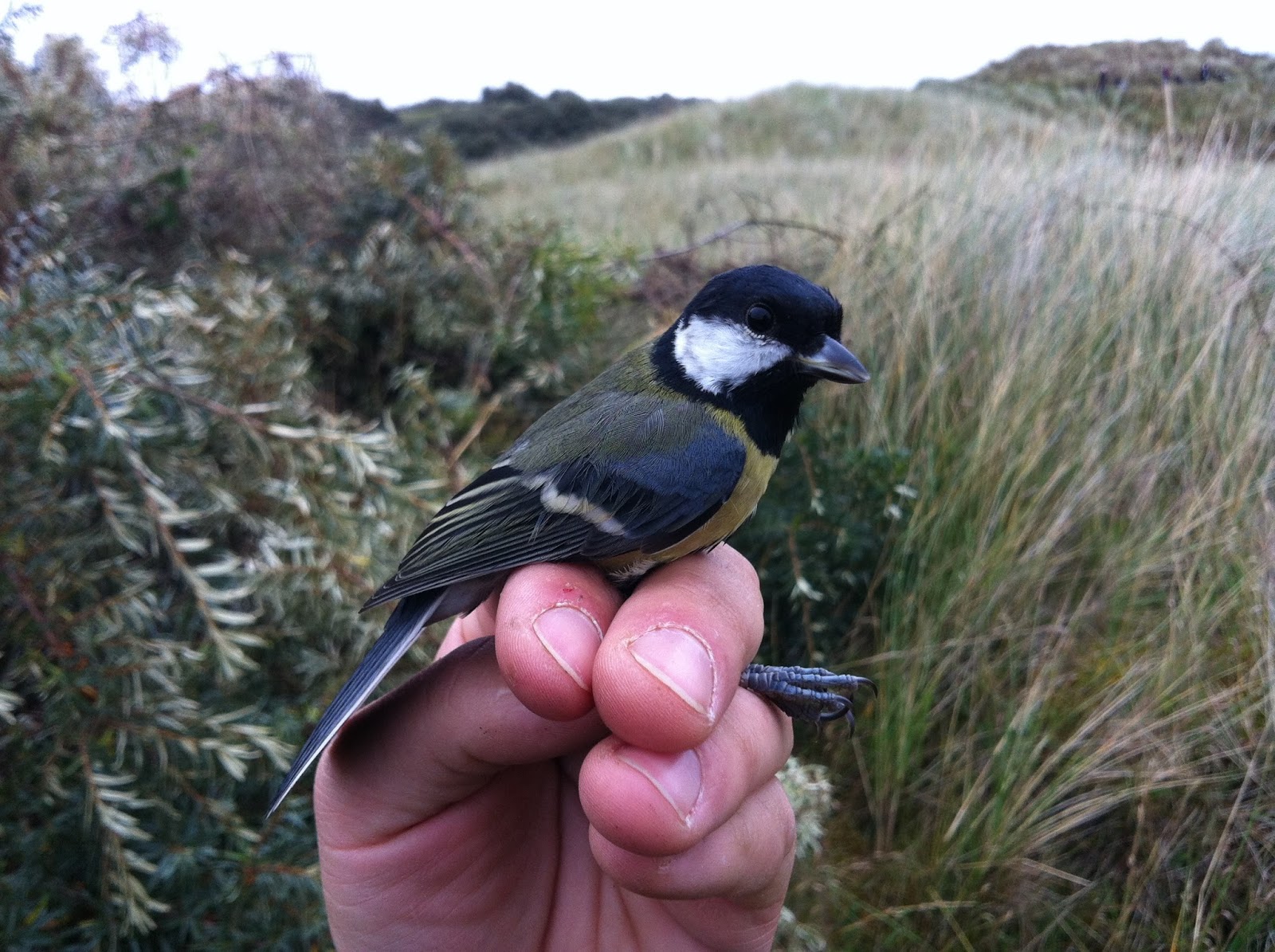
Showing posts with label Blue Tit. Show all posts

Saturday, 2 November 2019

Return to Lough Neagh - 2019

After the great success of our Lough Neagh ringing site in recent years we were very keen to get back on the shore and open the nets. Making best use of the bank holiday weekend and a good weather, we decided to go for the first visit on Saturday 13th of July. John and I were short on helpers and lost three people the day before but we were joined by two fairly new trainees in Abbie and Rich K.

Sedge Warbler

In the last few years, the first rush of birds is usually underway as we are setting the nets, so we decided that an earlier start was needed. We set off form Coleraine at 04.30am, arriving at the parking area around 05.30am, on site 30 mins later after the walk in with the gear and then a further 30 minutes to get the 7 nets (run of 4 & 2) opened.

The catch was another busy one with 119 new birds including another 76 new Sedge Warblers, 10 more Reed Warblers and our first two Grasshopper Warblers for the site.

                                      New         Retrap
Blackcap                          3
Grasshopper Warbler      2
Reed Bunting                  7                1
Reed Warbler                 10
Robin                              1
Sedge Warbler               76               1
Willow Warbler            19
Wren                               1

Total                              119              2     

                                                                         Reed Bunting

Visit two took place a few weeks later on the 27th of July. We had planned for this morning with a team of 11 assembled but the weather changed & we had to bring it a day forward, leaving it with just myself, Steve, Abbie and also Joe, who had travelled all the way from Donegal.
As usual with the site, the onslaught of birds began at once and two nets were closed early and further two furled temporarily. The birds die off completely by 10 am.
The result was a big haul of 220 new birds which included 20 Reed Warblers, surely an Irish daily record. The 167 Sedge Warblers ought to be up there for a record catch also.

            
                                       New         Retrap
Blackcap                          15
Chiffchaff                         2
Dunnock                          3
Grasshopper Warbler      1
Reed Bunting                  3
Reed Warbler                 20
Robin                              4
Sedge Warbler              167              
Willow Warbler            19
Wren                               1

Total                              119                  

We didn't catch any retraps and given that we have previously ringed 782 birds in 6 visits here, the birds are clearly moving through the site


Yet again we managed just the three visits despite all our hopes and talk! Visit three took place on the 25th of August where we had a good team assembled with John, Ken, Jim Mc, Abbie, Rich K, James O and Nathan giving us a team of eight. With extra hands we increased the nets and covered four net sites with nine nets. It was a bright hot day which seemed to effect the birds. It was the first time at Blackers Rock that we haven't had a big movement of birds early doors and instead there was a steady trickle right through, until we took down the nets. There were much fewer birds seen and heard but there were still lots skulking amongst the reeds. We were only really catching birds in the shaded parts of the nets, often just a few feet on some.
It was another healthy catch of 154 new birds, a BTO control Sedge Warbler and a single retrap Blackcap, although we would have liked 300+!


                                       New         Retrap
Blackcap                          6                1
Blue Tit                        7
Chiffchaff                        3
Goldcrest                         1
Grasshopper Warbler      1
Reed Bunting                  12
Reed Warbler                 25
Robin                              7
Sedge Warbler              80
Swallow                         3              
Willow Warbler            11
Wren                              2

Total                              154                  


I've totted up the totals and put them in the table below. It was somewhat similar to last year in that the middle visit (27th July) produced the biggest numbers with more Sedge Warblers and the final visit (25th August) produced the greatest species diversity. 491 new birds compared to 2018's 464.


Sedge Warbler - 323 (1 BTO control, 1 retrap)
Reed Warbler - 55
Willow Warbler - 34
Blackcap - 24 (1 retrap)
Reed Bunting - 22 (1 retrap)
Blue Tit - 7
Robin - 6
Chiffchaff - 5
Grasshopper Warbler - 4
Wren - 4
Swallow - 3
Dunnock -3
Goldcrest -1
Total - 491 new birds


Although we had a great team of 8 for visit three, the first two visits (visit 1 - 13th July) were limited by only having four people present, particularly on visit 2 with two trainees, a C and A dealing with 220 birds which could have been much more. Weather was again difficult and there was a full month between the 2nd and 3rd visits and it twice put off plans of ringing on two consecutive days.
Reed Warbler numbers again peaked at the end of August, maybe they are even better in early September? The catches on the 27th July and 25th August were each record daily catches for Northern Ireland, probably Ireland also. The guys at Traad Point at the north of the Lough have caught 58 Reed Warblers throughout the c10 CES visits so a bumper year for Reed Warbler in the north.
Willow Warbler numbers were almost double this year while Reed Bunting numbers were quite a bit lower after the exceptional catch of 53 new birds on the 11th of August last year. Sedge numbers seemed like they might be a little lower this year after visit one but we caught a record catch of 167 on the 2nd visit, 70 more than our next best days catch.
Just the one control in the form of a Sedge Warbler bearing a BTO ring - it hadn't travelled far, having been ringed at Traad Point CES 10 miles up the shore but pleasing all the same as its our first exchange of birds.


No doubt we will get anther 2-3+ recoveries of birds heading south or on the way back north next spring. We only caught two inter-year retraps and one same year retrap, so we are still missing much of the local breeding population.
Bigger and better next year! (if the Irish weekend weather allows it).

Wednesday, 21 June 2017

May/June Ringing Update


Sand Martin season is back upon us and the first visit to Grangemore has kicked things off in style.  Pre-holiday I had noticed a number of new burrows on the main sand bank, a new colony of around 15 pairs on the golf course at Portstewart Strand across the river where they were excavating sand and 3/4 pairs had recolonized the sand banks at the Barmouth, so numbers in the estuary were looking up.
On arrival last Wednesday there were over 70 birds perched along the fences above the bank with many juveniles amongst them and a further 50 flying around the site.  David and I quickly got the nets up in front of the burrows and immediately caught a dozen birds flying out.  The conditions were actually very breezy but the bank was perfectly sheltered on the outer bend of the smaller Articlave River.


Over the next hour or so we caught an impressive total of 135 new birds and 12 retraps.  Given the quantity of birds we were not recording biometrics and simply ringing, ageing, sexing and release.  The totals were 61 males, 48 females, 35 juveniles and three were unsexed adults.  This total is greater than the three visits last year combined so it could be a very big year.  I did count the number of likely active burrows but I don't have a notion what that was now - maybe c85-100!  The retraps were mostly from the colony from the previous year but one was one of the birds that has moved from our other colony 12.6km away which we caught here last July.  Another was the single bird I had caught in the reedbed close by a few weeks ago.  The first visit to Macfin is due very soon and any trainees are welcome to come along (c150 pair colony).

Juvenile Sand Martin

Following the visit to the Sand Martin colony we still had a few hours to spare before lunch so we decided to do some river ringing, which was a first for David.  We opted for one of the better spots where we regularly catch both Dippers and Kingfishers and the odd Grey Wagtail.

With the 6m net up across the river it wasn't long before a female Kingfisher came up river at full speed but unfortunately managed to flip out of the net within 5 seconds.  We had to wait another 10-15 minutes before some Dippers appeared down river and one duly flew in the net but the other thought better of it.  The male Kingfisher was being very vocal just up river for 10 minutes before it to dropped into the net. 
A decent morning and some great experience for David handling 2 new species and 149 birds!

Kingfisher

Back on the 19th of May I spent a morning checking the 75 nest boxes in the wood in the Glens of Antrim (after a quick look a few weeks previous) and things have improved after the initial year of the scheme in 2016.  This year there were 17 active nests with 9 Blue Tit, 7 Great Tit and a single Coal Tit nest.  The nests were at very different stages with some of the Blue Tits on eggs and the early Coal Tits had already fledged some young.  I didn't ring all the chicks as some were too large and ready to burst or too small.

Healthy Blue Tit brood ready to fly the nest

When I entered the wood I had picked up the distant utterings of a Wood Warbler so I spent 10 minutes following the trail and tracked down the smart displaying male.  This was a first for me and a very uncommon bird in Northern Ireland with no breeding records for the past few years, only 2-3 sightings in that period and probably the only pair in Northern Ireland (a female was located a few weeks later).

The Great Spotted Woodpecker is continuing its charge across Ireland and reached the Glens of Antrim last year.  The study wood is ideal habitat with large old trees and some dead standing trees and has had a female for over a year.  There were quite a few vocal calls (chiuck chiuck (kind of)) but I didn't have a chance to track them down.  I had given another birder the heads up about the Wood Warblers and he managed to find a GSW nest with two chicks, so brilliant news for the wood!  I did pay a visit on my return from holidays but the chicks appear to have fledged.  I'm not sure how the male has been so evasive as I'm not aware of any sightings.  When there, I also checked half the boxes and all occupied nests fledged their young bar one which still contained a brood of Blue Tits which were suitable for ringing.  


Last year a pair of Tree Sparrows took up residence in a nestbox at Grangemore but unfortunately failed at the egg stage.  This year things had improved and we had two active nests, one with three eggs and another with two.  I had left the follow up visit for a little longer than I hoped and found that the nest with 3 eggs had fledged and the other nest had a well developed chick and a cold egg.  There are around a dozen boxes scattered around the abandoned small farm so hopefully the box uptake will continue to improve.  I have checked to see if they will attempt a second brood but seemingly not.


We have made two visits to Portstewart Strand in the past 6 weeks and although things have been relatively quiet the first wave of juveniles are flitting between the bushes.  I hope to visit again this coming weekend as we will be kept off site for the following two weeks as Portstewart Golf Club are hosting the 2017 Irish Open which is going to be massive with tens of thousands of spectators!  Himalayan Balsam has started to take root at the site so I spent half an hour trying to remove all the plants before they seed.  I pulled 529 plants, some a few inches high and am hoping that I got the lot but the river will continue to deposit more seeds given that it drains almost two thirds of Northern Ireland.

529 Himalayan Balsam plants

Portstewart Strand 26/05-17/06/2017                           
                                New       Retrap    

Blackbird                 1            
Dunnock                  4                2

Chaffinch                 1                                         
Linnet                      11              

Meadow Pipit           1              
Robin                       2

Song Thrush            2
Stonechat                 1                        
Willow Warbler        3              
Wren                        2               1


Totals                      28             3                    


Juvenile Robin


When I was away John paid a visit to the River site at the University and caught around 20 birds which included five adult Blackcaps and half a dozen juvenile Blackbirds.  He has also been hunting out bird of prey nest sites but again the Long-eared Owls have beaten us to it with a few juveniles perched amongst the trees.

Long-eared Owl chicks   (copyright of John Clarke)


Saturday, 3 December 2016

Quick Start to Winter

The Sea Buckthorn bushes at Castlerock Golf Course are still drooping from the weight of the millions of bright orange berries and attracting good numbers of birds.  The first frosts seem to have trigged the fermentation of the berries and they are beginning to ooze with an aroma of what I'd imagine an alcoholic Balsamic Vinegar would smell like. 
There are good numbers of Blackbird, Song Thrush, Chaffinch, Greenfinch and Bullfinch gorging on the berries but the hoped for winter thrushes are lacking with only a couple of Fieldfare floating by and a single Redwing overhead.
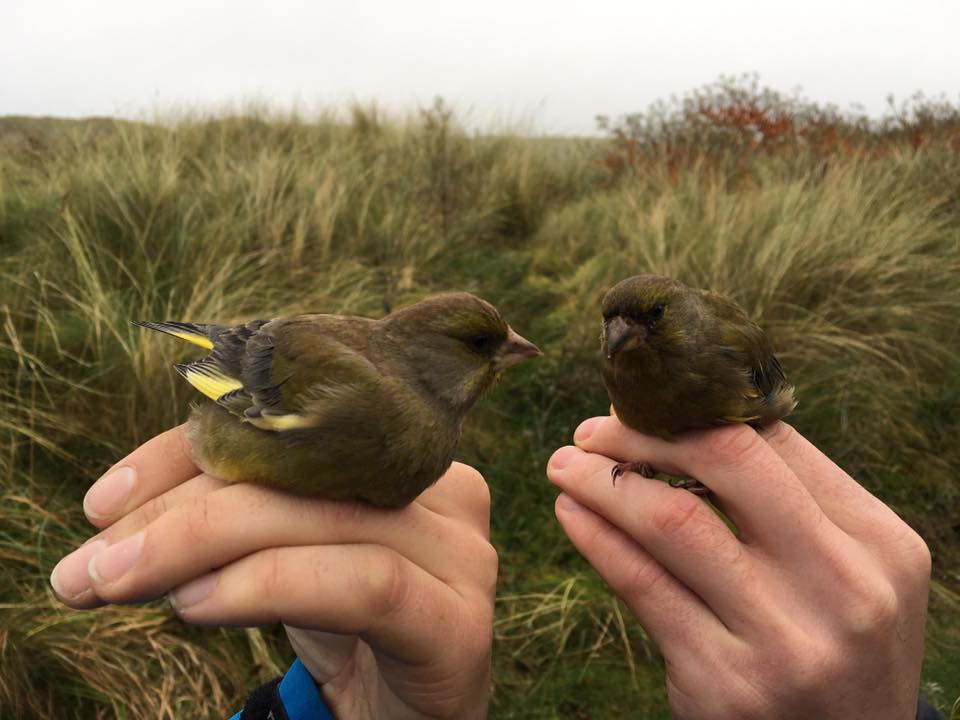
On the first visit last Saturday David, Dean and I spent half an hour clearing the brambles etc. from the net rides but we were up and running fairly quickly.  We trapped a total of 35 new birds including the first Greenfinches I've caught this year (hard to come by these days) plus our first fledged House Sparrow for the year and the first for the estuary.

Greenfinches

Dean and I were down again this morning with another decent catch of 27 new birds and 6 retraps from the previous week.  The best of the birds was a female Blackcap which are always special birds in winter.  The nice morning was boosted with the sightings of Harbour Porpoises, Grey Seal and 54 species of birds including 1500+ Lapwing, Peregrine, Red-throated Diver, Gannet, Goldeneye and a patch tick in the form of a female Pheasant - species 122 for the patch this year!           

Blackcap

PSS Ringing Totals 26/11/2016 + 03/12/2016
                                New      Retrap
Blackbird                   4                          
Blackcap                   1
Blue Tit                    13              3
Bullfinch                    4
Chaffinch                 15             
Dunnock                   1            
Goldcrest                  1
Goldfinch                  1
Greenfinch                8
House Sparrow         1
Reed Bunting            1  
Robin                        7              3
Song Thrush             5          

Total                        62             6            


Sea Buckthorn

We didn't visit the site until the end of December last year (when we also set it up) and we anticipate the berries to last at least March, so that should keep is busy until the return of spring.

Dean and David with the ringing buggy (handy for the walk to get to the site)

In my traipsing's across the Bann Estuary I have found a few great pools which hold good numbers of Snipe and the odd Jack Snipe.  I visited one of these pools 3/4 weeks and flushed 69 Snipe in a relatively small area.  Before the first visit to Castlerock we thought we would put up a couple of nets and see if we could catch any before dawn. It didn't go quite as planned and the c20 Snipe we flushed all swung left and flushed out over the estuary rather than going straight towards the nets.  We devised a new plan and gave it a quick attempt a few evenings later, this time with a line of 58 metres of net parallel with the shore and 18m at 90 degrees on the end.  Unfortunately while setting the nets before darkness we managed to flush 16 Snipe even though we were trying to be as quiet as possible.  There were only 2 birds left in the pool as we splashed through and again they missed.
We will probably give it one last attempt but set the nets in complete darkness early morning to see if that does the trick! 


You may remember that we had sighted a couple of Long-eared Owls roosting in the scrub at Portstewart Strand during the ringing attempts in October so we thought it would be worth a go at catching them.  We have had a bit of luck in the past at mist netting the birds in darkness at the University but the success rate, is of course, very low.
John and Dean gave it a first attempt at PSS last week and managed to attract three LEO's in the vicinity of the nets and one bird was very close to being trapped but unfortunately it veered to the side of the net.
We gave it another attempt last night with the net placement tweaked a little but to no avail.  We may have glimpsed a bird ghost behind us but that was about the height of it.
We did strike with two Redshanks, caught in a net placed along the mudflats in the low tide. 

A few weeks back I joined David and Phil from Copeland Bird Observatory to help run the first of this winters ringing training programme in Antrim.  We had a full quota of 5 trainees and had a pretty good morning, although we were restricted to around 3 hours.  The site has a fantastic supply of berries, a small orchard, a wild bird seed cover field and a couple of feeders, so plenty to work with.  There were a large number of Linnets, House Sparrow and Chaffinch feeding in the 'wild bird table' and we managed to catch a small fraction, including 20 Linnet and 2 House Sparrow.  The small orchard was rammed with Blackbirds on arrival but only 6 were caught.  We can only access the site after 08.30, so we miss the opportunity to get the nets up before first light but a catch of 72 new birds was still great!


CBO Winter Training - Antrim 19/11/2016
                                New      Retrap
Blackbird                   6              1            
Blue Tit                      5              1
Bullfinch                    1   
Chaffinch                  11             2
Coal Tit                      2
Dunnock                     1          
Goldcrest                    2
Great Tit                    13            1           
House Sparrow           2
Lesser Redpoll           1
Linnet                        20
Long-tailed Tit            5
Robin                         2              1
Song Thrush              1           

Total                          72             6            

House Sparrow

There will be a further 4 training events from now to March, with one a month, then it's back to the Observatory for the 2017 season. 


Our ringing attempts for the rest of the year will probably be more of the same, although we may return to the university to try and catch some LEO at the traditional site.  When down and around Portstewart Strand in the dark we heard pretty big numbers of waders roosting on the far side so we may return to Grangemore for another attempt or two. 

The Blog has hit a new milestone in the last few days topping the 25k mark, sitting on over 25700 this evening.  The reading rate has certainly increased as time has gone on and the next 25k should hopefully come much faster!


Tuesday, 24 May 2016

Nest boxes and PSS 22/05/2016

On Saturday morning, with the weather looking a little bit hit and miss, John and I headed over to the Glens of Antrim to check out our latest next box scheme.  There are a total of 75 boxes, of which 15 are open faced.  The boxes have been purposefully placed in clusters of five to ensure vacant boxes are available to potential migrants from Africa looking to set up home.  With this in mind and being the first year of the scheme, we weren't expecting uptake to be that great. 

Blue Tit

We managed to find all 75 boxes, which is a good start, but I had mapped them with using a GPS and if you find one, you know there are 4 others close by!  The boxes are generally separated into the lower woodland and upper woodland, with a difference in height of some c75 metres.  In the lower wood we found 3 of the 30 nest boxes occupied, all with Great Tits - 5 eggs, 4 eggs and 3 one day old chicks.  In the upper woodland Blue Tits were a little more prevalent with three occupied nests with 10 eggs, 8 eggs and 8 eggs.  There were a further two Great Tit nests, both with 5 eggs.  In general the occupied nests were well spread, with the exception of two Blue Tit occupied boxes in the same tight cluster. 

Example of boxes and placement

We didn't hear any of the target species in the woodland but we did locate five Spotted Flycatcher territories with 9 birds noted.  All the nests in the woodland are very late and I would suggest they are probably at least 16 days behind that of the nest at Portstewart Strand below.  I may pay another visit in the first week of June and see if there is any change!

More information on the project is available on this previous post - http://causewaycoastrg.blogspot.co.uk/2016/02/springs-around-corner.html

A view down the lower glen, with the conical Ailsa Craig visible in the centre and Sanda Island to the left


On Sunday morning I opted to make the most of the fine conditions and headed down to Portstewart Strand.  I wasn't overly optimistic, being in the lull between the end of migration and the first juveniles appearing, so I gave myself another couple of hours in bed.  Conditions were very sunny, so I stuck to the net rides amongst the scrub, which are now in full leaf and create a bit of cover. 

Whitethroat ♀

The birding was pretty decent as I added four new species for the year, two of those site ticks.  The new birds for the site were a drake Garganey and a female Scaup.  Given the time of year, I spent a bit of time attempting to turn the Scaup (Greater) into a Lesser Scaup... but not this time.  The other new birds for the year were a Little Egret and a female Whitethroat that appeared in the nets mid-morning.  Both species are pretty uncommon in the estuary with just one record of each last year involving 3 and 2 birds respectively. 

Scaup ♀ (I'll get a proper camera eventually...)

The ringing was limited with only sixteen new birds ringed plus a couple of retraps.  Included in the new birds were 9 well developed Blue Tit chicks from one of the four nest boxes on the site.  As mentioned before the Whitethroat was a nice catch and it was the first for the site.


Portstewart Strand 22/05/2016                                 

                                   New       Retraps          
Blackbird                    1                1                                                                 
Blackcap                     1
Blue Tit                       9               
Bullfinch                     1                1               
Dunnock                     1                1              
Lesser Redpoll           1
Song Thrush               1
Whitethroat                1
                   
Total                          16                3             


We are approaching the busy summer season when a few of the seasonal projects kick into gear.  The Sand Martin colonies first visit will be coming up mid June with further visits at the start of July and the final visit in mid July.  Storm Petrel season starts in July, running through to the end of August.  The Sandwich/Common Tern colony will be visited at the start of June to count nests/eggs with follow up visits a few weeks apart to ring the chicks.  The autumn will also see a few attempts at catching roosting Swallows in the estuary.  The remainder of the next boxes will be visited and revisited if necessary.  All that plus our general mist netting will keep us busy right through until autumn migration when our focus will once again return to Portstewart Strand. 
Helpers are always welcome so give us a shout if you are interested. 

Monday, 7 December 2015

Irish Bird Ringing Data - Crests and Tits


Five species of Tit have been ringed in Ireland since 1975 and one of those I have included by name default - Bearded Tit (Reedling).  The other four are widespread breeders - Blue, Coal, Great and Long-tailed Tit.  The only other species of Tit recorded in Ireland that has not been ringed is Marsh Tit, following a short lived unofficial introduction of birds in a woodland in the south. 
Only two species of Crest have been ringed/recorded in Ireland - Goldcrest, a widespread breeder and Firecrest, an uncommon passage migrant.  A close relative from North America has also been recorded - Ruby-crowned Kinglet, with one being trapped at Cape Clear BO in 2013.  It is very rare in the Western Palearctic with only two previous records which came from Iceland in the 90's.  Given that only one RcK has been ringed, I won't go into any detail.


Firecrest

Firecrest are almost annual along the south coast on migration, but records have tailed off a bit in recent years.  2015 proved to be a very productive year with 40+ birds recorded between Sept-Nov.  The previous years were less so, with potentially just the one in 2014, 12 in 2013, three in 2012 and two in 2011.  Generally most of the records come in the Autumn but in the odd year, such as 2013, they came in the spring.  One or two birds will also winter in Ireland but these records are few and far between.  Firecrest is a rare bird in Northern Ireland.
The graph below shows a trend of greater encounters with birds through the 80's and early 90's with much fewer records since 2008, with only one record.  A total of 79 were ringed in this period in the south, with six in the north.  There were at least seven ringed in Ireland before this period but again I only have partial records for then.       


Goldcrest


The Goldcrest is a common breeder throughout Irelands forests and they are one of the few species who inhabit the dense coniferous plantations.  The majority of the birds are caught at coastal migration points and offshore islands in the spring and autumn.  They are typically short lived, averaging about two years, so the majority caught are first year birds.
There was a huge invasion this autumn, when Goldcrests hit Britain in their thousands, with perhaps 100+ bearing rings from Fennoscandia, Poland, Belgium, Holland, Denmark and the Baltic States.  Ireland didn't seem to feel the effects and ourselves (CCRG) on the north coast actually caught less than last year with increased effort!
Going by the graph below it would seem that these eruptions have happened before, particularly in 1989 when 1,825 were ringed, followed by the second most productive year of 1988 with 1,182.  There was probably association in these two years, with a good spring following a bountiful autumn.  2009 was the quietest year with only 91 caught across Ireland.
A total of 19,535 have been ringed in Ireland since 1975. 


The recovery map below shows a strong correlation of birds using the Irish Sea islands and the south coast of England but that is where the majority of the ringers assemble!  I am surprised that there is only a single record coming from the north, as I thought there would have been quite a few more.  Copeland Bird Observatory is a focal point but it is difficult to say if these birds are coming out of Ireland or if they are coming from Scandinavia/Scotland without more ringing records.  Certainly when the birds pass through/leave Ireland they all seem to move south/east, with all recoveries going to Britain, although the results may be biased as I discounted all inter-Ireland movements which may have shown otherwise. 

       Goldcrest recoveries - green in, red out


Bearded Tit

As of 2011, Bearded Tits returned to Ireland as a breeding bird after a 26 year absence.  They again bred in Co. Wexford in 2012 & 2013 and may have done so in 2014-15 but I do not have the data - there have certainly been birds present.  The species seems to come in small fluxes along the east coast, with birds recorded in Louth in 1966, Wicklow 1974-1985 (breeding proved in 1976 and 1982-1985) and further records in Wexford in 1989 and Cork 1979-81.
The only ringing to target the species took place in the early 80's and ceased when breeding was confirmed in 1985. 


Long-tailed Tit

A tiny resident breeder, that spends much of the year in family groups, often numbering over a dozen birds.  During ringing sessions, it is often the case that if you catch one or two of the family group, the rest will join them in the pockets of the mist nets, responding to their relatives calls. 
The numbers caught from year to year is very staggered with some striking differences.  The species notoriously does not fair well in prolonged cold spells and may go in some way to explain the changes but undoubtedly not the only reason.  The trends between north and south show the complete opposite at times and this suggests that ringing effort may be a major factor.
The greatest number ringed in one year was in 1975 with 383, with the lowest coming in 2001 with 72.  A total of 7,788 have been ringed in Ireland since 1975. 


In general most of our Tit species are rather sedentary and this is the reason that there are so few recoveries.  From the data available to me, I found only two movements in or out of Ireland. 
The first was a Great Tit ringed at Portmore Lough, Co. Antrim, that found its way to Greater Manchester four years later, unfortunately succumbing to a window.  The second was a fast moving Blue Tit that made its way from Bardsey Bird Observatory to Cape Clear Bird Observatory, covering 354 km in 18 days.  I also included two interesting inter-Ireland movements.  One was a Great Tit moving from Dublin to County Tyrone and the other was a Coal Tit moving 268m km from Cape Clear BO to County Offaly in the midlands - potentially an immigrant to Ireland. 

                                                     Tit recoveries - Green in, red out and blue inter


Great Tit


Another common breeding species across Ireland, generally in wooded areas.  The majority are caught at feeding stations, plus many pullus ringed in nest boxes. 
There appears to a general trend of increasing numbers of Great Tit being ringed since 1975.  The lowest total came in 1978 with 266 birds trapped, rising to the most productive year in 2014 with 1,441.  A total of 31,566 have been ringed in Ireland since 1975.


Blue Tit


A species similar to Great Tit in habits and trapped in a similar manner.  They are a delightful looking bird but are feisty little things and can be tricky to extract from mist nets.
Overall the trend seems relatively steady, although there are many more peaks and a few troughs.  1985 was the most productive year with 2,140 and 1978 the least with 690.  A total of 53,232 have been ringed in Ireland since 1975. 


Coal Tit


The majority of these records will refer to the Irish race of Coal Tit, Periparus ater hibernicus.  British and Continental Coal Tits do appear on the offshore islands and coastal watch points in autumn but no distinction has been made for birds ringed.
Generally the number of Coal Tits ringed seems steady with only one large dip (256 & 214) in 2006-2007 and a large spike (933) in 2012.  The majority of Coal Tits are ringed around feeding stations and the numbers really increase in prolonged bad weather in winter, when the birds descend from the coniferous plantations into Irish gardens. 
A total of 9,193 Coal Tits have been ringed in Northern Ireland since 1977, with 7,588 in the south.